

Writing a research paper can feel overwhelming. You sit down to write, and suddenly everything feels unclear. What should go first? How much detail is enough? How do you make your paper logical and convincing?

AI Tools to Make Your Research Easier
 AnswerThis – Write structured research papers faster.
Try AnswerThis: https://answerthis.io/
 Moara – Discover and organize literature reviews efficiently.
Try Moara: https://www.moara.io/
 – Extract key insights from research papers in seconds.
Try SciSpace: https://scispace.com/
 Thesify – Get expert-style feedback on your thesis.
Try Thesify: https://www.thesify.ai/
Here’s the good news. You don’t have to figure everything out from scratch.
There are simple frameworks that help you structure each part of your research paper. Think of them as roadmaps. They tell you what to include and in what order. They make your writing clearer, faster, and more professional.
In this blog, we will look at 6 powerful frameworks that cover every major section of a research paper.
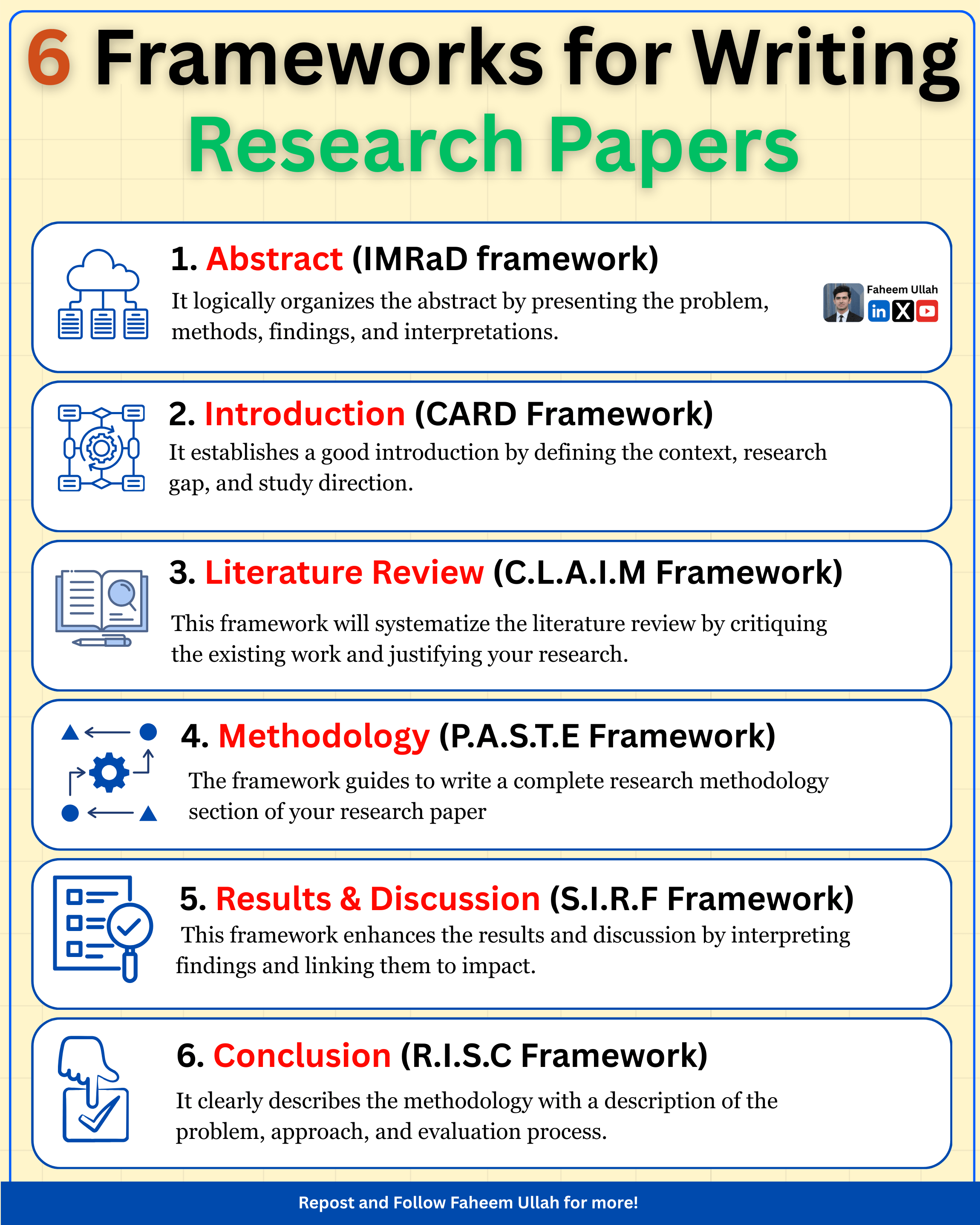
1. Abstract — The IMRaD Framework
Let’s start with the abstract. This is the first thing people read. Many readers decide whether to continue based only on this section.
The IMRaD framework helps you organize your abstract clearly. IMRaD stands for Introduction, Methods, Results, and Discussion.
First, briefly introduce the problem or research question. What issue are you studying? Why does it matter?
Next, explain the methods. What did you do? Was it an experiment, survey, model, or analysis?
Then, share the main results. What did you find?
Finally, give the interpretation or conclusion. What do the results mean? When you follow IMRaD, your abstract becomes structured and easy to understand. Readers quickly see the purpose, approach, findings, and impact of your work.
2. Introduction — The CARD Framework
The introduction sets the stage for your research. Many students struggle here because they either write too broadly or jump into details too soon.
The CARD framework helps you build a strong introduction. CARD stands for Context, Aim, Research gap, and Direction.
Start with the context. Introduce the topic area. Show why it is important in the real world or academic field.
Then move to the research gap. What is missing in existing studies? What problem has not been solved yet?
After that, clearly state the aim of your study. What are you trying to achieve?
Finally, give the direction of your paper. Briefly explain how you will approach the problem.
This framework makes your introduction logical. It smoothly moves the reader from the general topic to your specific contribution.
3. Literature Review — The C.L.A.I.M Framework
A literature review is not just a summary of other papers. It is a critical discussion that shows you understand the field.
The C.L.A.I.M framework helps you write a more analytical literature review.
First, C – Cite the key studies in your area. Show what researchers have already done.
Then, L – Link related studies together. Don’t discuss each paper in isolation. Show connections and trends.
Next, A – Analyse the strengths and weaknesses of existing research. Where do methods fall short? Where do findings disagree?
After that, I – Identify the research gap. What is still unknown or unresolved?
Finally, M – Motivate your research. Explain how your study addresses the gap.
When you use CLAIM, your literature review becomes a story. It leads naturally to your research question.
4. Methodology — The P.A.S.T.E Framework
The methodology section explains how you conducted your research. It must be clear enough that someone else could repeat your work.
The P.A.S.T.E framework gives a simple way to structure this section.
Start with P – Participants or Population. Who or what did you study? This could be people, datasets, or experimental samples.
Then describe A – Approach. What research design did you use? Was it experimental, qualitative, or computational?
Next, explain S – Steps. What procedures did you follow? How did you collect data?
After that, describe the T – Tools. What instruments, software, or equipment did you use?
Finally, discuss E – Evaluation. How did you analyse the data? What statistical or analytical methods were applied?
PASTE ensures that your methodology is complete and well organized.
5. Results & Discussion — The S.I.R.F Framework
Many researchers struggle to connect results with meaning. They present numbers but forget to explain their importance.
The S.I.R.F framework helps combine results and discussion effectively.
Start with S – Summary of findings. Present the key results clearly. Use tables or figures if needed.
Then move to I – Interpretation. What do these findings mean? Do they support your hypothesis?
Next, provide R – Relation to literature. Compare your results with previous studies. Are they similar or different?
Finally, discuss F – Future implications. How do your findings impact the field? What future research can build on your work?
SIRF turns raw results into meaningful scientific insight.
6. Conclusion — The R.I.S.C Framework
The conclusion is your final message to the reader. It should not introduce new data. Instead, it should wrap up the story of your research.
The R.I.S.C framework helps you do this effectively.
Start with R – Restate the problem. Remind the reader what issue you addressed.
Then provide I – Insights gained. What are the key takeaways from your study?
Next, discuss S – Significance. Why do these findings matter in theory or practice?
Finally, end with C – Closing thoughts. Suggest future directions or final reflections.
A good conclusion leaves the reader with a clear understanding of your contribution.
Chapter 8: Conclusion
The conclusion chapter summarizes and synthesizes all the information collected over the PhD project. This chapter returns to the research questions, summarizes and unifies all the findings and contributions made in this thesis.
In addition to summarizing what this research study has done for the academic community, the student will also provide insight into how this study has aided in advancing our understanding of this subject area and offer an account of what he/she has learned during the research project.
Even though it may be shorter than other chapters, the conclusion can be a powerful tool for conveying what has been learned and contributions made through research and should answer the question: “What contributions have been made to knowledge through this PhD?”
Final Thoughts
Writing a research paper becomes much easier when you stop guessing and start following proven structures.
These 6 frameworks — IMRaD, CARD, CLAIM, PASTE, SIRF, and RISC — guide you through every major section of a research paper. They improve clarity, logic, and flow. They also help reviewers understand your work faster.
Next time you write a paper, try using these frameworks as a checklist. You’ll notice your writing becomes more focused and professional.
Research writing is not just about knowledge. It’s about communication. And these frameworks help you communicate like a pro.
Don’t forget to read: Which tool to use in each phase of your PhD?
Hello Dr. Faheem,
Thank you so much for your regular email update. So far, in this newsletter I've learnt that how to structure a research paper in each section and subsection, rigorously articulate each sub section in order to have clear, logically coherent, and scholarly research paper from first draft to polished manuscript. Thank you so much again.