You’ve got the email.
Your PhD interview is scheduled.
Now the question is — how do you prepare? Whether it’s an online call or an in-person meeting, your PhD interview is your chance to show more than just grades. It’s about curiosity, fit, and potential.
How to convert your thesis into a research paper?
Join my webinar on 27 November.
Registration Link: https://www.airmeet.com/e/bacbc830-be25-11f0-9e4b-295920fb9e27
What will I cover?
A step-by-step process to automatically transform your thesis into a publishable paper.
Let’s make sure you walk in confident and walk out proud.
Here’s your ultimate PhD Interview Cheat Sheet — clear, simple, and based on what real supervisors look for.
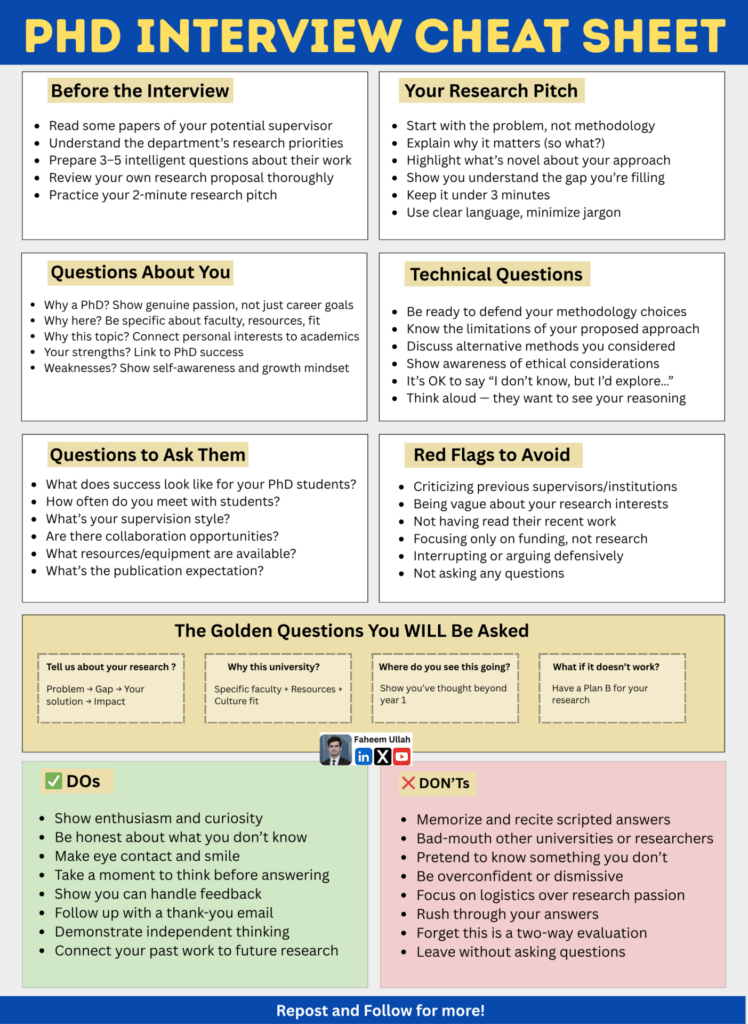
Before the Interview
Preparation matters more than perfection.
Before the interview, take time to understand the people and place you’re applying to.
- Read some papers by your potential supervisor.
Know their main research themes and recent projects. It shows genuine interest. - Understand the department’s research priorities.
Every university has key areas they focus on — align your proposal with those. - Prepare 3–5 intelligent questions about their work or the program.
Avoid generic ones like “What’s the funding like?”
Instead, ask things like:
“How does your team approach interdisciplinary research?” - Review your own research proposal thoroughly.
Expect questions about your methodology, objectives, and motivation. - Practice your 2-minute research pitch.
You’ll need it — short, sharp, and clear.
Your Research Pitch
Think of this as your “elevator talk.”
In two to three minutes, you should make them say, “That’s interesting!”
Here’s how to structure it:
- Use clear, simple language.
No need to impress with jargon — impress with clarity. - Start with the problem — not the method.
What’s the issue you’re trying to solve? - Explain why it matters.
Why should anyone care? What’s the impact? - Highlight what’s novel.
What makes your approach different or better? - Show that you understand the research gap.
This tells them you’ve done your homework. - Keep it under three minutes.
If they want more, they’ll ask.
Questions About You
This part is all about fit. Supervisors want to see if you’ll thrive in their group.
- Why a PhD?
Show passion for research, not just career ambition.
Say something like: “I enjoy solving complex problems and want to contribute to real-world knowledge.” - Why this university or department?
Mention specific professors, resources, or projects that align with your interests. - Why this topic?
Connect your background and curiosity to the research area. - What are your strengths?
Link them to PhD success — persistence, curiosity, organization. - What are your weaknesses?
Be honest but strategic.
Say something like: “I used to overcommit, but I’ve learned to manage my time better.”
They’re not looking for perfection — they’re looking for self-awareness.
Technical Questions
Yes, they will ask about your research plan.
But don’t panic — they’re testing how you think, not what you know.
- Be ready to defend your methodology.
Why did you choose qualitative over quantitative?
Why that sample size? - Know your limitations.
Every method has weaknesses. Acknowledge them. - Discuss alternative methods.
Show that you’ve explored different options. - Be aware of ethics.
If your work involves humans or data, know your ethical procedures. - It’s OK to say, “I don’t know.”
Follow it up with: “…but I’d explore it by doing X.” - Think out loud.
- Supervisors like to see your reasoning process, not just the final answer.
Questions to Ask Them
Remember — a PhD interview is a two-way conversation, not an interrogation.
You’re also evaluating them.
Here are smart questions to ask:
- What does success look like for your PhD students?
- How often do you meet with students?
- What’s your supervision style?
- Are there collaboration or industry opportunities?
- What resources or labs are available?
- What’s the publication expectation?
Good questions show that you’re serious, practical, and thinking ahead.
Red Flags to Avoid
Many strong candidates lose points for small mistakes. Don’t be that person.
Avoid:
- ❌ Criticizing previous supervisors or universities.
- ❌ Being vague about your research interests.
- ❌ Not reading the interviewer’s recent work.
- ❌ Talking only about funding, not research.
- ❌ Interrupting or arguing defensively.
- ❌ Staying silent when asked, “Do you have any questions?”
These small things can make a big difference.
The Golden Questions You WILL Be Asked
Almost every PhD interview includes some version of these four golden questions.
Prepare short, confident answers for each.
- What if it doesn’t work?
Every good researcher has a Plan B.
Talk about how you’d pivot or redesign your study. - Tell us about your research.
Use a simple formula: Problem → Gap → Solution → Impact. - Why this university?
Mention specific faculty, labs, or resources.
Talk about culture fit and collaboration. - Where do you see this going?
Show that you’ve thought beyond Year 1.
For example, how will your work contribute to your field long-term?
DOs for Your PhD Interview
Here’s what every successful candidate does:
- Connect your past to your future.
Link your previous projects or jobs to your PhD goals. - Show enthusiasm and curiosity.
Passion beats perfection every time. - Be honest about what you don’t know.
Research is about learning, not pretending. - Make eye contact and smile.
Confidence matters — even online. - Take a pause before answering.
Thinking for a second shows maturity. - Show you can handle feedback.
Supervisors look for teachability, not arrogance. - Follow up with a thank-you email.
Gratitude leaves a lasting impression. - Demonstrate independent thinking.
Show that you can lead your research, not just follow instructions.
DON’Ts for Your PhD Interview
Avoid these common mistakes that make interviewers lose interest:
- Don’t memorize scripted answers.
It sounds robotic. Be natural. - Don’t bad-mouth other researchers.
It shows a poor attitude. - Don’t pretend to know something you don’t.
It’s okay to admit uncertainty. - Don’t act overconfident or dismissive.
Confidence is good; arrogance isn’t. - Don’t focus too much on logistics.
They care more about your research passion than office space or schedules. - Don’t rush your answers.
Speak calmly and clearly. - Don’t forget that it’s a two-way evaluation.
You’re also deciding if they are the right fit for you. - Don’t leave without asking questions.
- Curiosity shows engagement.
Final thoughts
Your PhD interview is not a test of perfection — it’s a conversation about potential.
Supervisors want to see your passion, curiosity, and willingness to learn.
Be yourself.
Show genuine interest in research.
And remember — the interview is not about knowing everything, it’s about showing how you think.
When you walk in prepared, confident, and authentic, you’ll stand out.
So take a deep breath.
Review this cheat sheet once more.
And go ace that PhD interview.
Want more practical PhD tips?
Subscribe to the Smart Researcher Newsletter for weekly insights, tools, and strategies to make your research journey smarter — not harder.
Best of Luck..
Find me on X ,You tube and LinkedIn