Do you need an AI tool for your research?
This is one of the best tools for literature review and writing research papers.
Trinka Link: www.trinka.ai
If you are starting your research journey, you’ve probably asked yourself this question:
“What type of research am I actually doing?”
You’re not alone.
Many PhD students and researchers struggle to clearly define the type of research they are conducting.
Understanding research types helps you plan better, choose the right methods, and write a stronger proposal or paper.
In this post, we’ll explore the main types of research — in simple words, with clear examples — so you can easily identify where your work fits.
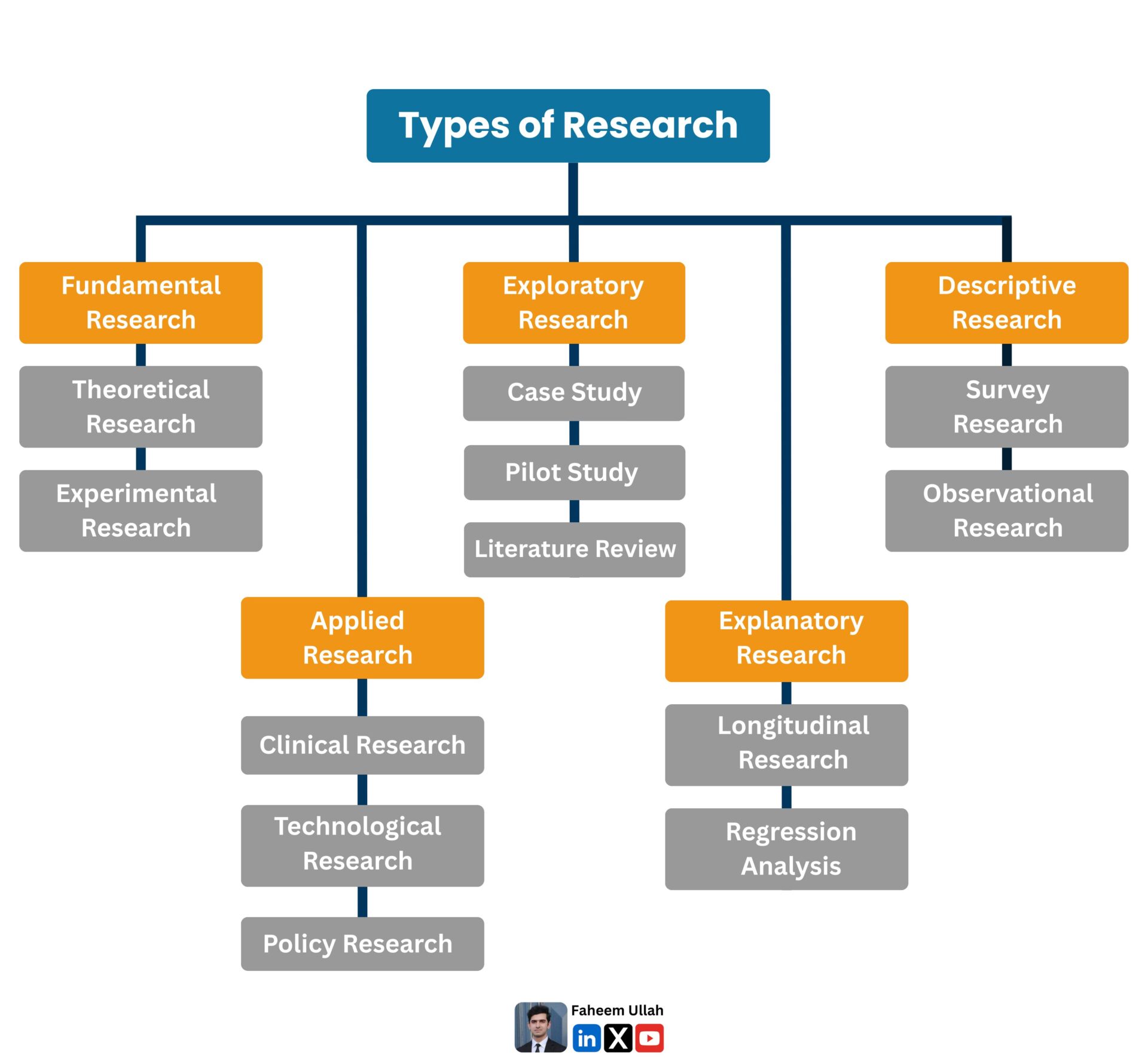
1. Fundamental Research
Also called basic or pure research, this type focuses on expanding knowledge rather than solving immediate problems.
It’s the “why” kind of research — done to understand the world better.
Subtypes
- Theoretical Research – Focuses on developing new theories or models.
Example: Studying how learning happens in the human brain. - Experimental Research – Tests hypotheses in controlled environments.
Example: Conducting lab experiments to test a new teaching method.
Pros
- Builds the foundation for future discoveries.
- Increases understanding of natural or social phenomena.
- Often leads to innovations later in applied fields.
Cons
- No immediate practical use.
- May take years before results have real-world impact.
In short:
Fundamental research seeks truth and understanding — not quick results.
2. Applied Research
Applied research focuses on solving real-world problems using the principles discovered through fundamental research.
If fundamental research is about why, applied research is about how.
Subtypes
- Clinical Research – Conducted in healthcare to improve treatments or diagnosis.
Example: Testing a new drug or therapy. - Technological Research – Develops new technologies, systems, or devices.
Example: Creating an AI tool for analyzing medical data. - Policy Research – Informs decision-makers and policymakers.
Example: Studying how education policies impact student performance.
Pros
- Directly useful to society.
- Often attracts funding and collaboration from industries.
- Leads to innovation and product development.
Cons
- Can be limited by specific contexts.
- Sometimes prioritizes short-term gains over long-term understanding.
In short:
Applied research bridges theory and practice — turning ideas into solutions.
3. Exploratory Research
This is the starting point of most research projects.
When you don’t yet have a clear idea or hypothesis, exploratory research helps you explore, identify patterns, and define your next steps.
It’s all about curiosity — exploring the unknown.
Subtypes
- Case Study – Examines one specific case in detail.
Example: Studying how one company implemented remote work policies. - Pilot Study – A small-scale version of a larger study, done to test feasibility.
Example: Running a mini experiment to check if your survey questions work. - Literature Review – Analyzes existing research to identify gaps.
Example: Reviewing published papers on “AI in education” to find what’s missing.
Pros
- Helps clarify the research problem.
- Builds a strong foundation for future studies.
- Encourages creative and flexible thinking.
Cons
- Findings are often preliminary, not conclusive.
- May not provide clear answers or results.
In short:
Exploratory research is like a compass — it helps you find direction when you’re unsure where to go.

If you need to use one tool for exploratory research, which one it should be?
It should be none other than SciSpace.
SciSpace can help you explore, identify research papers, and design hypothesis.
Try SciSpace Agent: www.scispace.com
4. Descriptive Research
Descriptive research tells you what is happening, but not necessarily why.
It’s used to describe characteristics, trends, or relationships in a population.
For example:
- What percentage of PhD students experience burnout?
- How many researchers use AI tools in their literature reviews?
Subtypes
- Survey Research – Uses questionnaires or interviews to gather opinions or data.
Example: Asking students about their online learning experience. - Observational Research – Observes people or events in real time.
Example: Watching classroom interactions to analyze student participation.
Pros
- Easy to conduct and analyze.
- Provides large amounts of factual data.
- Great for identifying patterns and trends.
Cons
- Does not explain causes or reasons.
- Risk of bias in responses or observation.
In short:
Descriptive research gives you the what, not the why — perfect for building data-driven summaries.
5. Explanatory Research
Now that you know what happens (from descriptive research), explanatory research tells you why it happens.
It’s used to test relationships between variables — cause and effect.
Subtypes
- Longitudinal Research – Studies the same subjects over time.
Example: Tracking how stress levels change across a PhD program. - Regression Analysis – Uses statistical models to find relationships.
Example: Testing how sleep affects research productivity.
Pros:
- Helps predict outcomes.
- Explains the causes behind observed patterns.
- Strengthens understanding of relationships among variables.
Cons:
- Requires more time, data, and resources.
- Results can be affected by external variables.
Explanatory research moves from “what’s happening” to “why it’s happening” — the heart of scientific reasoning.
6. How These Types Work Together
Research is not always one type.
Often, researchers combine different approaches across their project.
For example:
- You might start with exploratory research to identify a problem.
- Then use descriptive research to collect data.
- And finally conduct explanatory research to find causes.
PhD students often mix methods depending on their question, time, and resources.
Here’s a quick example:
A student exploring “AI use in higher education” might:
- Begin with a literature review (exploratory),
- Conduct surveys with teachers (descriptive),
- And analyze correlations using regression (explanatory).
That’s the beauty of research — every method builds on another.
Why Knowing Research Types Matters
Understanding research types is not just academic — it’s strategic.
Here’s why:
- You’ll write clearer proposals and papers.
- You’ll choose the right tools and data collection methods.
- You’ll explain your research design confidently during your viva or defense.
- You’ll know how to justify your choices to reviewers.
If you can say, “My research is explanatory and uses regression analysis to study…”
— you immediately sound professional, clear, and credible.
Quick Summary
| Type of Research | Focus | Example |
|---|---|---|
| Fundamental Research | Expanding knowledge | Studying how learning works in the brain |
| Applied Research | Solving real-world problems | Testing a new medical device |
| Exploratory Research | Finding direction | Reviewing AI tools for education |
| Descriptive Research | Describing patterns | Surveying student satisfaction |
| Explanatory Research | Explaining relationships | Studying how stress affects productivity |
Final Thoughts
Research is not one-size-fits-all.
Every project fits somewhere on the research spectrum — sometimes in more than one category.
The key is clarity.
Know what type of research you’re doing, why you’re doing it, and how it fits your goals.
When you can answer those questions confidently, you’re already halfway through your PhD.
So the next time someone asks, “What kind of research do you do?”
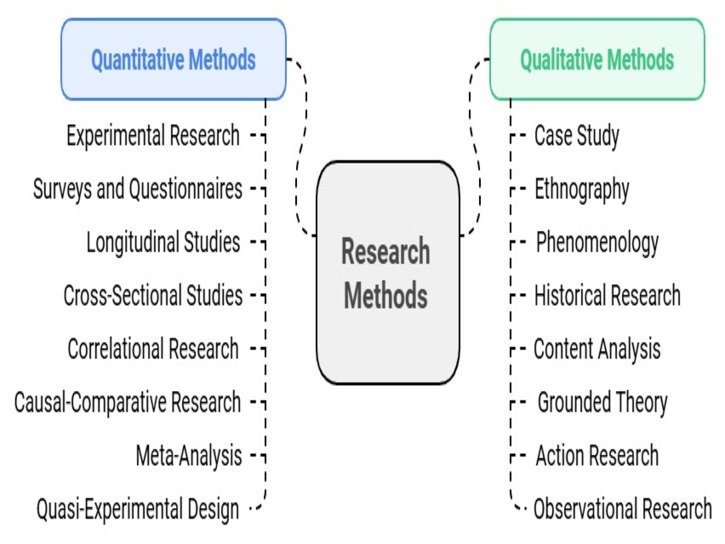
Don’t just say, “Qualitative” or “Quantitative.”
Say something like:
“I’m doing applied exploratory research through case studies.”
That’s how a smart researcher answers.
Do you want to learn how to use AI tools for your literature review?
Join my free webinar on coming Thursday.
Registration link: https://luma.com