Many students ask the same question:
“Is a Master’s thesis the same as a PhD thesis?”
The short answer is: No.
They may look similar from the outside, but they are very different in purpose, depth, and expectations.

Do you need an all-in-one tool for research?
Try SciSpace: www.scispace.com
It offers many FREE features ranging from literature review to paper writing.
If you are planning graduate study, preparing for a research track, or thinking about a PhD, this guide will make the difference crystal clear.
Let’s compare Master’s Thesis VS PhD Thesis using 7 key criteria.
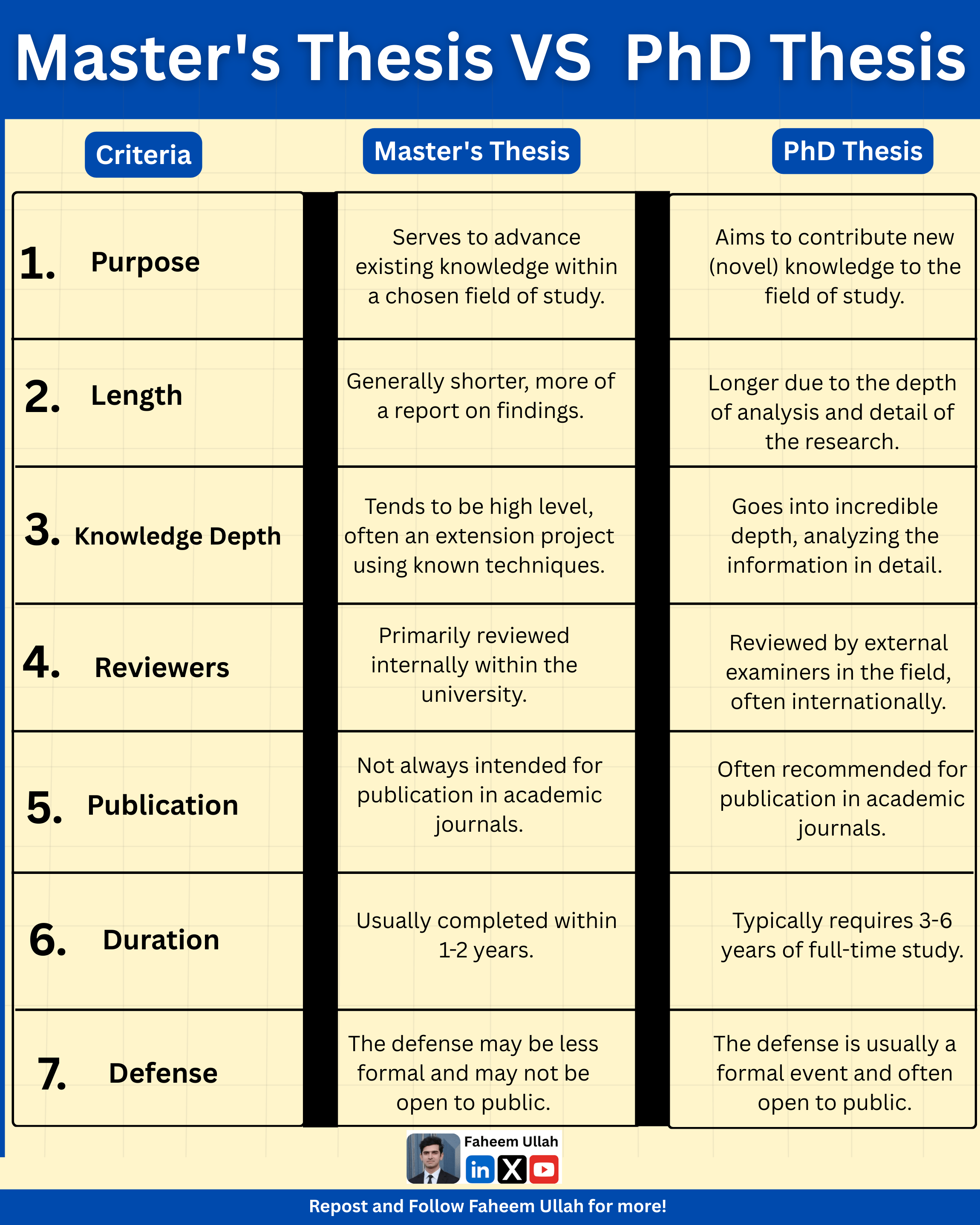
1) Purpose: What are you trying to achieve?
The purpose is the biggest difference.
A Master’s thesis is mainly written to show that you understand a topic deeply and can apply research methods correctly. It usually builds on existing ideas, frameworks, and theories. It is more about learning and demonstrating competence.
A PhD thesis, on the other hand, has a much bigger goal. A PhD thesis must contribute new (novel) knowledge to the field. This means your work should add something original. It can be a new model, new system, new theory, or a strong new insight that did not exist before.
In simple words:
PhD thesis = prove you can create new knowledge
Master’s thesis = prove you can do research
2) Length: How long is it?
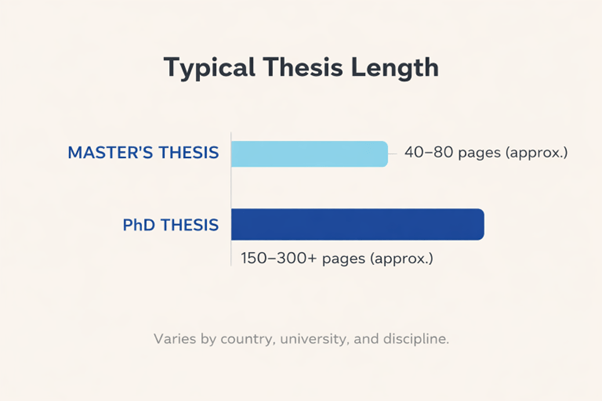
A Master’s thesis is shorter.
It is often like a structured research report.
A PhD thesis is much longer, because it includes deeper exploration, more evidence, and more complex analysis.
The exact length depends on your university and field, but typically:
- Master’s thesis is manageable and focused
- PhD thesis is extensive and detailed
Also, in PhD, the literature review is longer, the methodology is more rigorous, and results are discussed at greater depth.
📌 If you want to learn how research writing is structured, read: How to Write a Research Paper
3) Knowledge Depth: How deep is the work?
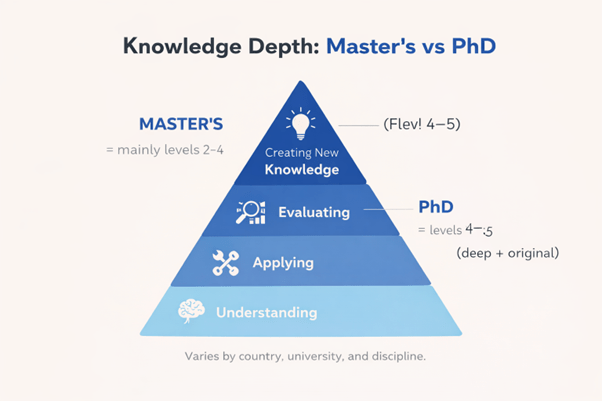
A Master’s thesis usually stays at a high level, and often uses known tools, methods, and techniques.
For example:
- Applying machine learning on a dataset
- Testing a known theory in a new environment
- Extending an existing framework
A PhD thesis goes into extreme depth.
It is not only about using methods. It is about questioning what exists and pushing boundaries.
You will:
- justify every decision
- defend your research design
- show why your work matters
- highlight what makes it new
That is why PhD research takes years. It involves deep thinking, experiments, validation, and strong academic writing.
📌If you want to understand academic writing structure better, read: How to Write Abstract of a Research Paper?
4) Reviewers: Who evaluates your thesis?

Do you want someone to identify weaknesses in your manuscript before submission?
Try Reviewer3: www.reviewer3.com
This tool uses 3 AI reviewers to identify weaknesses and 10× your chances of acceptance.
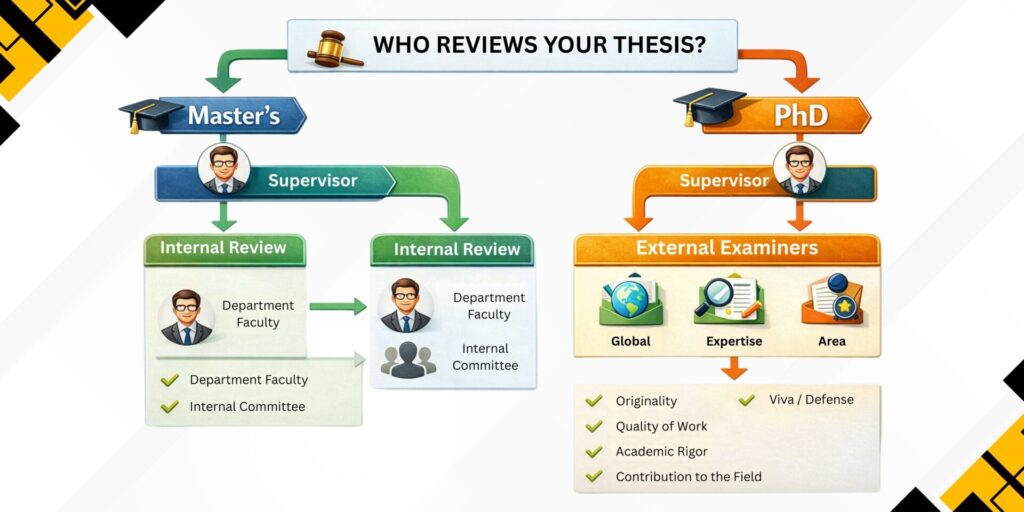
In a Master’s thesis, the evaluation is usually internal.
This means your thesis is mostly reviewed by:
- your supervisor
- department faculty
- internal committee
In a PhD thesis, reviewers are often external examiners, sometimes international. These reviewers are experts in your research area. They check:
- originality
- quality of work
- academic rigor
- contribution to the field
This is why PhD standards are stricter. You are not only proving something to your university. You are proving it to the research world.
5) Publication: Does it lead to published papers?
A Master’s thesis is not always written for publication.
Some Master’s theses become papers, but many are mainly for degree completion.
A PhD thesis is often strongly linked to publication. In many universities, PhD students must publish in journals or conferences before final submission.
That’s because the PhD is about producing research that contributes new knowledge. Publication becomes a natural result of that.
📌Related reading: Thesis VS Research Paper: Key Differences
6) Duration: How long does it take?
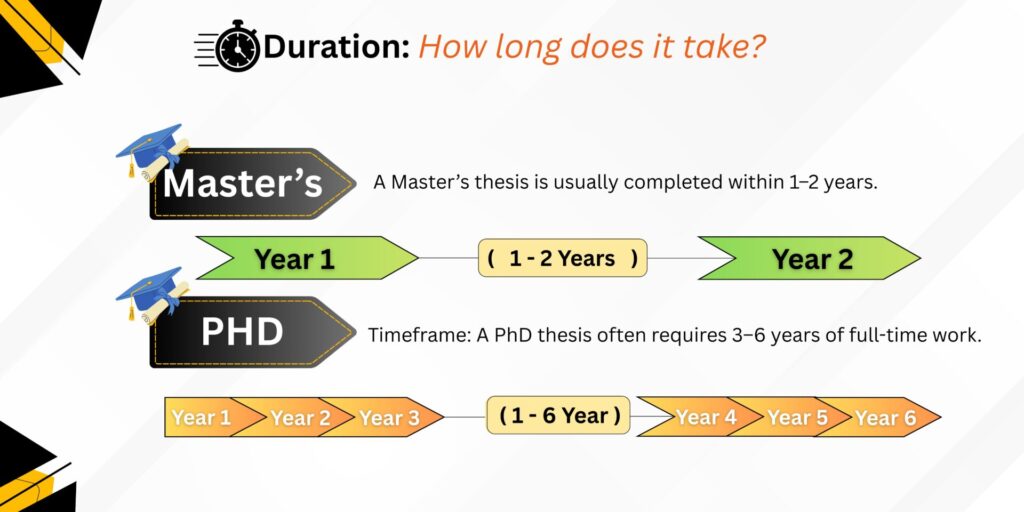
A Master’s thesis is usually completed within 1–2 years.
A PhD thesis often requires 3–6 years of full-time work.
This includes:
- publication and defense preparation
- proposal development
- literature review
- research design
- data collection
- experiments/analysis
- writing and revisions
7) Defense: Is the final defense different?
Master’s thesis defense can be less formal.
In some universities, there is a presentation and internal questioning. Sometimes it is not open to the public.
PhD thesis defense is usually a major formal event. It often includes:
- viva voce (oral examination)
- extensive questioning
- evaluation by expert examiners
- public participation (in many universities)
This final defense is a key part of proving you deserve the title of “Doctor”.
Final Thoughts: Which one is right for you?
A Master’s thesis is a great choice if you want to:
- build research skills
- explore a topic deeply
- prepare for professional growth
- decide if research is for you
A PhD thesis is right if you:
- want to become a researcher/academic
- enjoy deep problem-solving
- want to create new knowledge
- can commit long-term to one topic
Both paths are powerful. But both require different mindsets.
If you are confused, start with a Master’s thesis.
Then move to a PhD when your research interest becomes clear.
Recommended reads on SmartResearcher.me
Thesis VS Research Paper: Key Differences