

Many universities now accept PhD thesis presented as a series of published articles rather than as traditional “monograph” style books. This type of thesis is becoming more common in the fields of science, engineering, medical and social sciences but many students doing their PhD do not know how to prepare and write/present this type of thesis.
If you are wondering about how to organize your literature review; or what chapters go into a PhD based on published articles. Then this Guide is written to help you understand the structure of your PhD Thesis and provides a step-by-step guide to completing the writing process using easy to understand language and the structure shown in the Image attached.

How to identify trends in research?
Use Patsnap Eureka for identifying research trends
-Eureka R&D is a free AI-powered search engine for academic research.
-It helps researchers explore technical questions and track research trends
-It uses insights from 200M+ patents and 210M+ scientific papers in one place.
Try Eureka: https://eureka.patsnap.com/
What is a PhD Thesis by Publication?
Writing a PhD thesis by publication means completing a PhD through a few smaller pieces of research that have been submitted for consideration by reputable journals, as opposed to writing one big, long thesis.
The PhD student would author several articles and submit them for publication throughout the period of their study. Each article they published or submitted would represent a core chapter in their final thesis with supportive introductory, methodology and conclusion chapters to join all the articles together.
The advantage of this type of thesis format is that it allows PhD students to have a publication associated with their studies when they graduate; this advantage can help students pursuing careers in academia and research.
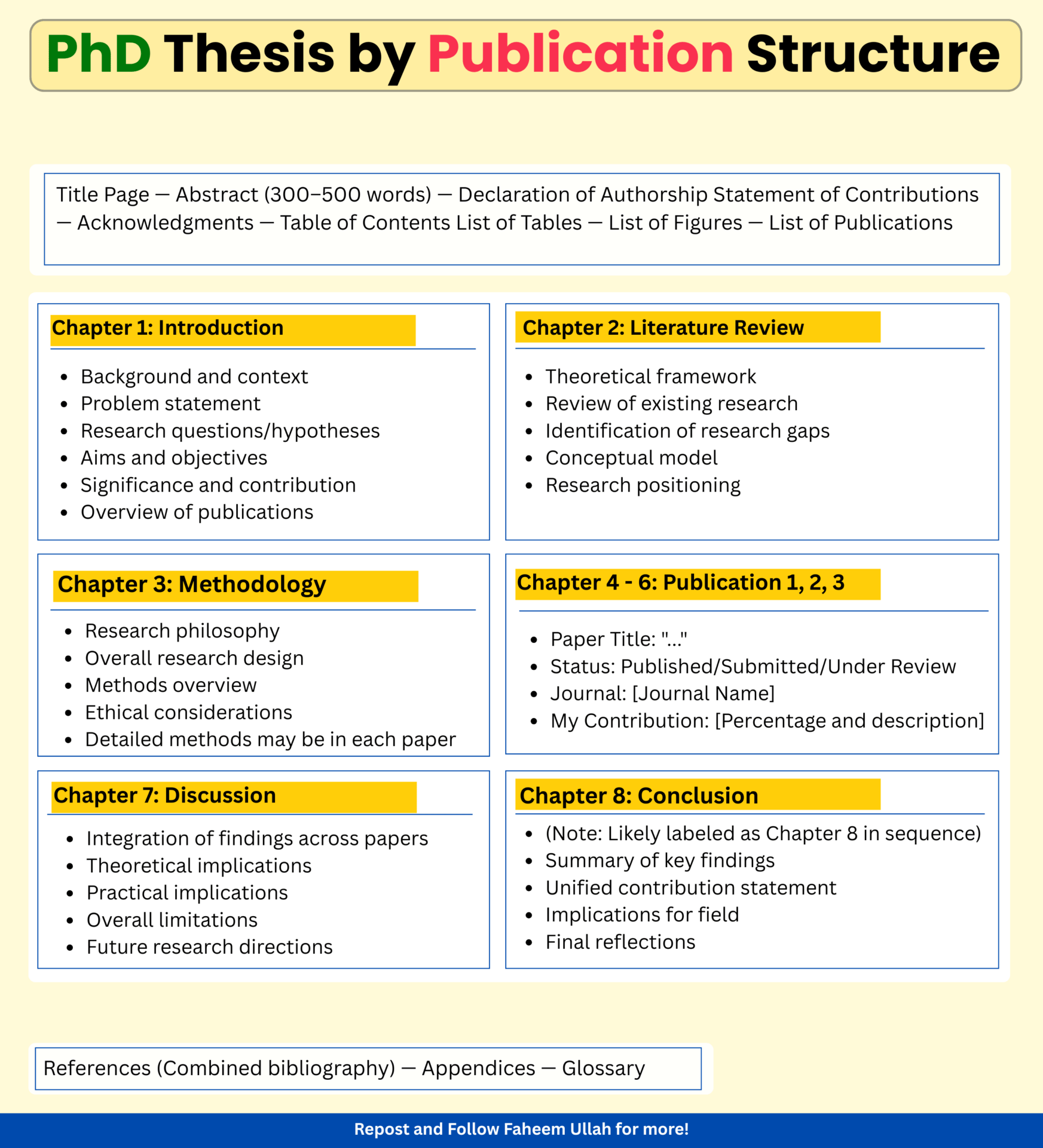
Front Matter: What Comes Before the Chapters
The traditional PhD thesis has a number of standard front sections that also appear in a thesis by publication. The standard front sections consist of a title page, an abstract (300-500 words), and acknowledgements.
The abstract provides the reader with a summary of the entire thesis as well as summarizes the major contributions of the author. After the abstract, the next section is the author’s declaration of authorship. In a thesis by publication, this declaration is especially important since many articles are written by multiple authors. The author of the thesis clearly describes what portion of each article was written by them.
After the declaration of authorship is the Acknowledgements section, which lists all individuals who contributed to the completion of the thesis. Following these two sections are, the table of contents, a list of tables, a list of figures, and a list of published papers included in the thesis. All these sections enable examiners to quickly see the structure and scope of the thesis.
Chapter 1: Introduction
The opening chapter of a PhD thesis is known as the Introduction. This chapter provides the reader with an understanding of your research and what it aspires to accomplish.
The student will outline the relevant background and establish the research area in this chapter, so the reader has an awareness of the importance of the research topic, including what problems currently exist in the area. Once this foundational knowledge has been built, the problem statement will be articulated followed by the research questions or hypotheses driving the overall PhD Program.
In addition to establishing the background context and problem definition, this chapter will communicate the research aims and objectives of the study. It will also explicitly state how the contributions of the study will create value and benefit to society. Given that this is a thesis by publication, the introduction will typically contain a summary of the papers published in this member’s PhD program, including how each paper fits with the larger theme of the research being conducted.

Do you need feedback on each chapter of your thesis?
Try Thesify: www.thesify.ai
This tool is specifically designed to help you in writing your thesis.
Chapter 2: Literature Review
This chapter demonstrates the candidate’s profound grasp of prior work. It integrates the findings of the review conducted separately for each individual paper, but rather than simply presenting those reviews, the integration in this chapter is critically integrated.
In this chapter, the candidate provides an overview of the theoretical framework(s) of their research and highlights some of the key studies in their area of study. They also examine what is missing from current research and how their PhD will fill those gaps. The purpose of the Literature Review is not simply to provide a summary of previous studies, but rather to provide a thoughtful critical examination of past studies so that readers can see where the candidate’s current research fits into the body of current knowledge.
Additionally, many candidates provide a conceptual framework in this chapter that depicts pictorially the relationship between various concepts/variables relevant to their dissertation research. By the conclusion of the Literature Review chapter, a reader should understand what has been previously researched, what has not yet been researched, and how the candidate’s research is important for the field.
Chapter 3: Methodology
Chapter 3 is dedicated to methodology, documenting the framework of the study through all chapters of this series of publications. The student gives a description of their philosophic approach to their research; that is, if it was quantitative, qualitative, or a mixture of both.
The overall structure of the research, as well as a description of the research approach, is addressed in this chapter. In addition to research philosophies, this chapter also focuses on ethical considerations for conducting research on human beings, and for conducting research that involves the collection of sensitive data or conducting research with human subjects or conducting experiments.
While each individual article within this body of work will address the specifics of methodology, Chapter 3 provides one central comprehensive methodological base for the thesis.
Chapters 4 to 6: The Publications
Chapters 4, 5, and 6 of the PhD Thesis with Publication represent the main body of research for the PhD. Each chapter typically contains one published, submitted or under review article.
At the beginning of each chapter, the author will present basic details of the specific article, such as article title, status of publication, and the name of the journal in which it was published. One of the key components at this stage is a statement outlining the author’s contribution(s) to the article, particularly if there are multiple authors on the article.
Typically, the complete articles are incorporated into new chapters of the doctoral thesis in the same format as the published articles or, in some cases, the articles may have been formatted according to university guidelines. These chapters represent the PhD doctoral research and accordingly provide the most compelling evidence of a doctoral researcher’s contribution to academic scholarship.
Chapter 7: Discussion
The Chapter on Discussion brings together all aspects of your thesis; instead of having separate discussions with each individual publication, the Discussion Chapter gives one picture of the results of each of the studies included in your thesis.
A few of the features included in the Discussion Chapter include integrating results from several studies, showing the relationship between various findings, showing the theoretical/practical implications, discussing the major limitations, and proposing future research directions.
The Discussion Chapter demonstrates to the examiner that the candidate has the capability to comprehend the implications of their work on an overall level as opposed to evaluating the work on an individual paper basis.

Do you want someone to identify weaknesses in your manuscript before submission?
Try Reviewer3: www.reviewer3.com
This tool uses 3 AI reviewers to identify weaknesses and 10× your chances of acceptance.
Chapter 8: Conclusion
The conclusion chapter summarizes and synthesizes all the information collected over the PhD project. This chapter returns to the research questions, summarizes and unifies all the findings and contributions made in this thesis.
In addition to summarizing what this research study has done for the academic community, the student will also provide insight into how this study has aided in advancing our understanding of this subject area and offer an account of what he/she has learned during the research project.
Even though it may be shorter than other chapters, the conclusion can be a powerful tool for conveying what has been learned and contributions made through research and should answer the question: “What contributions have been made to knowledge through this PhD?”
Final Sections: References and Appendices
A comprehensive bibliography brings together the references located in each chapter and publication related to this thesis project. Appendices contain items such as surveys, lengthy tables, and/or alternative evaluation results.
Final Thoughts
PhD thesis formats have evolved into this publication format primarily due to the current research focus in higher education. The PhD student can complete their doctorate and use their thesis to create an archive to the PhD student’s publications during their degree process. The format also represents the way many PhDs are now produced.
To be effective in this format, the PhD candidate must consider the design and content of the thesis; have strong mentoring and direction from the PhD advisor; combine the articles and chapters together, and/or have a supportive environment (academic or research) to facilitate the preparation of this document.
For a PhD candidate to succeed with their thesis by publication, they must first ensure that they understand the structure of this type of thesis; once that has been completed, they will understand how to effectively develop their thesis documents accordingly.
Dear Dr. Faheem,
Thank you so much as usual for your regular weekly update. This newsletter helps me inspiring and motivating to enhance my engagement and dedication to my PhD research project.