Writing a PhD thesis can feel like climbing a mountain.
You start full of energy but soon realize how steep the path is.
The truth is — every great PhD thesis follows a structure.
It’s not just about writing; it’s about telling your research story clearly and logically.

Do you need feedback on each chapter of your thesis?
Try Thesify: www.thesify.ai
This tool is specifically designed to help you in writing your thesis.
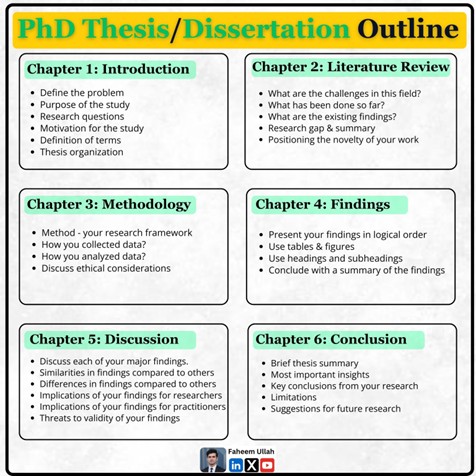
This guide breaks down the six key chapters of a PhD thesis or dissertation.
Each chapter has a purpose. Each connects to the next like pieces of a puzzle.
Let’s go step-by-step.
Chapter 1: Introduction
The introduction is the heart of your thesis.
It sets the stage, defines the problem, and tells readers why your research matters.
Here’s what to include:
- Define the problem – What issue or gap are you addressing?
- Purpose of the study – Why did you choose this topic?
- Research questions – What specific questions guide your study?
- Motivation for the study – Why is this research important to you or to society?
- Definition of terms – Explain key concepts or jargon so readers can follow.
- Thesis organization – Give a roadmap of what’s coming in each chapter.
Tip: Write this section last. Once you’ve finished your research and other chapters, it’s easier to introduce your work clearly.
Your introduction should make readers say, “Yes, this topic is worth exploring.”
Chapter 2: Literature Review
The literature review is where you build the foundation for your research.
It shows that you’ve done your homework and understand what others have said before you.
Here’s what to cover:
- What are the challenges in this field?
Summarize the big problems or debates in your topic area. - What has been done so far?
Discuss major studies, theories, and results related to your work. - What are the existing findings?
Highlight what researchers already know. - Research gap and summary
Identify what is still unknown or missing. That’s your gap. - Positioning the novelty of your work
Show how your research fills that gap or adds something new.
Tip: Don’t just summarize — analyze and compare.
Show how previous research connects (or doesn’t connect) to yours.
Your literature review should end with a clear statement like:
“While many studies have explored X, little attention has been paid to Y. This study addresses that gap.”
Chapter 3: Methodology
This chapter answers one simple question:
“How did you conduct your research?”
It’s your blueprint — showing readers your research design and process.
Here’s what to include:
- Method – your research framework
Explain the overall approach (qualitative, quantitative, or mixed). - How you collected data
Describe participants, tools, and procedures. - How you analyzed data
Mention the techniques or software used (e.g., SPSS, NVivo, Python). - Discuss ethical considerations
Explain how you handled privacy, consent, or potential risks.
Tip: Be transparent and detailed.
Your goal is to help others replicate your study if they wanted to.
The methodology chapter proves that your findings are credible, valid, and ethical.
Chapter 4: Findings
Now comes the exciting part — presenting your results.
This is where you show what you discovered.
Here’s how to structure it:
- Present findings in logical order
Start with major themes or results, not random data. - Use tables and figures
Visuals make complex results easier to understand. - Use headings and subheadings
Organize content clearly for easy navigation. - Conclude with a summary of the findings
End each section with key takeaways.
Tip: Let the data speak.
Don’t interpret too much yet — that comes in the next chapter.
This chapter should answer your research questions clearly and objectively.
Readers should see what you found, not what you think about it (yet).
Chapter 5: Discussion
This is where you explain what your results mean.
It’s your chance to connect your findings to the bigger picture.
Here’s what to include:
- Discuss each of your major findings
Explain what each result tells you. - Compare similarities and differences with other studies
Do your results support or challenge previous work? - Discuss implications for researchers and practitioners
Why do your findings matter? Who benefits from them? - Highlight threats to validity
Be honest about any limitations or biases.
Tip: Be critical but confident.
Show that you understand your results deeply — both their strengths and weaknesses.
The discussion chapter is where your thinking skills shine.
It turns your data into meaning.
Chapter 6: Conclusion
The final chapter wraps up your entire research story.
It’s short but powerful — the part readers often remember most.
Here’s what to include:
- Brief thesis summary
Remind readers of your topic, methods, and main results. - Most important insights
Highlight your biggest discoveries. - Key conclusions from your research
What did you learn? What’s the takeaway message? - Limitations
Acknowledge any constraints or weaknesses honestly. - Suggestions for future research
Recommend what others can explore next.
Tip: End on a positive note.
Show how your work contributes to knowledge and inspires future studies.
Your conclusion is your final impression — make it count.
Putting It All Together
Let’s recap the structure of your PhD thesis:
| Chapter | Focus | Key Goal |
| 1. Introduction | What, why, and how of your research | Set the stage |
| 2. Literature Review | What’s already known | Identify the gap |
| 3. Methodology | How you did it | Show your research process |
| 4. Findings | What you found | Present your results |
| 5. Discussion | What it means | Interpret your findings |
| 6. Conclusion | So what? | Summarize and suggest next steps |
Each chapter builds on the previous one.
Together, they create a complete and logical flow — from problem to solution, from question to discovery.
Bonus Tips for Writing a Great PhD Thesis
✅ Start early — writing takes more time than you expect.
✅ Keep your supervisor in the loop — feedback saves time later.
✅ Don’t aim for perfection in your first draft — just write.
✅ Use reference managers like Zotero or Mendeley.
✅ Take breaks — a clear mind writes better.
Remember: Your thesis is not just a document; it’s a journey of learning.
Final Thoughts
Your PhD thesis is your voice in the research world.
It’s your chance to contribute something new — something that lasts.
Don’t overthink it.
Follow the structure, stay consistent, and tell your research story clearly.
Every great thesis begins with one step: writing that first page.
So open your document and begin today.
You’ve got this — and the world is waiting to read your ideas.