If you are a researcher or a PhD student, you already know this feeling.
You sit down to write something important…
A cover letter. An email to a supervisor. A research proposal.
And then you stare at a blank page.
You don’t know where to start.
You rewrite the same things again and again.
You waste hours on formatting instead of focusing on your ideas.
This is where templates change everything.
Templates save time. They reduce stress. They improve quality.
And most importantly, they help you move faster in your research journey.
In this blog, I’ll share the most useful templates every researcher should have, along with links and simple explanations.





Why Templates Are So Powerful
Before we jump into the list, let’s understand one thing.
Templates are not about copying.
They are about starting strong.
A good template gives you:
- A clear structure
- The right tone
- Key sections you should not miss
Once you have that, you just focus on your content.
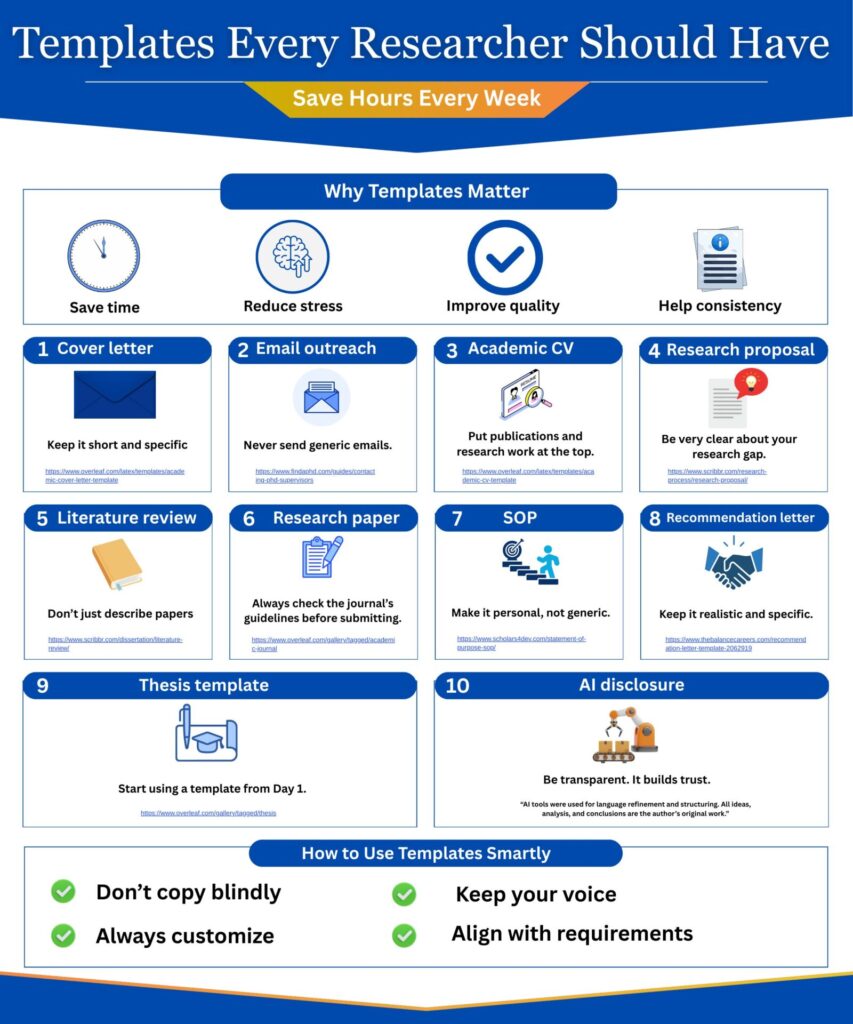
1. Cover Letter Template (For Journals & Jobs)
Writing a cover letter is one of the most confusing tasks for researchers.
You keep asking:
- What should I include?
- How formal should it be?
- How long should it be?
A good cover letter template solves all this. Try this:
This template helps you:
- Introduce your research clearly
- Highlight your contribution
- Show why your paper fits the journal
Tip: Keep it short and specific. Editors don’t like long letters.
2. Email Template (Supervisor / Professor Outreach)
This is one of the most important templates.
A good email can get you a fully funded PhD.
A bad email gets ignored.
This helps you:
- Write a clear subject line
- Introduce yourself properly
- Align your research with the professor
Tip: Never send generic emails. Always personalize.
3. Academic CV Template
Your CV is your academic identity.
But many researchers:
- Use messy formats
- Miss key sections
- Don’t highlight achievements properly
Use this clean CV template:
This helps you structure:
- Education
- Publications
- Research experience
- Skills
Tip: Put publications and research work at the top.
4. Research Proposal Template
This is the most critical document for:
- PhD applications
- Grants
- Scholarships
Try this structured template:
This template helps you include:
- Research problem
- Objectives
- Methodology
- Expected outcomes
Tip: Be very clear about your research gap. That’s what reviewers care about most.
5. Literature Review Template
Many students struggle with literature reviews.
They:
- Summarize papers randomly
- Don’t connect ideas
- Miss research gaps
Use this guide: https://www.scribbr.com/methodology/literature-review/
This helps you:
- Organize studies by themes
- Critically analyze papers
- Identify gaps
Tip: Don’t just describe papers. Compare and critique them.
6. Research Paper Template (IMRaD Structure)
Most journals follow a standard structure:
Introduction → Methods → Results → Discussion (IMRaD)
Use this template:
This helps you:
- Follow journal standards
- Structure your paper clearly
- Avoid formatting issues
Tip: Always check the journal’s guidelines before submitting.
7. Statement of Purpose (SOP) Template
For scholarships and admissions, SOP is crucial.
This helps you:
- Tell your story
- Show your motivation
- Connect your past and future
Tip: Make it personal, not generic.
8. Recommendation Letter Template
Sometimes you need to draft your own recommendation letter.
Use this:
This helps structure:
- Your strengths
- Achievements
- Potential
Tip: Keep it realistic and specific.
9. Thesis / Dissertation Template
Formatting a thesis is painful.
Margins, headings, references… everything takes time.
Use ready templates:
This saves hours by:
- Pre-setting formatting
- Structuring chapters
- Managing references
Tip: Start using a template from Day 1.
10. AI Disclosure Template (Very Important Now)
With AI tools becoming common, many journals require disclosure.
Here’s a simple version you can use:
“AI tools were used for language refinement and structuring. All ideas, analysis, and conclusions are the author’s original work.”
Tip: Be transparent. It builds trust.
How to Use Templates Smartly
Templates are powerful. But only if used correctly.
Here’s how you should use them:
- Don’t copy blindly
- Always customize
- Keep your voice
- Align with requirements
Think of templates as a starting point, not the final version.
Final Thoughts
If you are serious about research, templates are your secret weapon.
They help you:
- Save time
- Reduce stress
- Improve quality
- Stay consistent
Instead of starting from scratch every time, you start with clarity.
And that changes everything.
Don’t forget to read: Which tool to use in each phase of your PhD?