What every PhD student should know before submitting

Do you want to know which journal will accept your paper?
Try Review-it – a tool that recommends the 10 most suitable journals for your paper.
Try it here: www.review-it.ai
Let me ask you a simple question.
Do you know what type of research paper you are writing?
Most PhD students say yes.
But journal rejections say otherwise.
Very often, papers are rejected not because the research is weak.
But because the paper type does not match the journal’s expectations.
Wrong structure.
Wrong focus.
Wrong contribution.
Today’s newsletter will fix that.
Let’s walk through the main types of research papers.
One by one.
In simple language.
No theory overload.
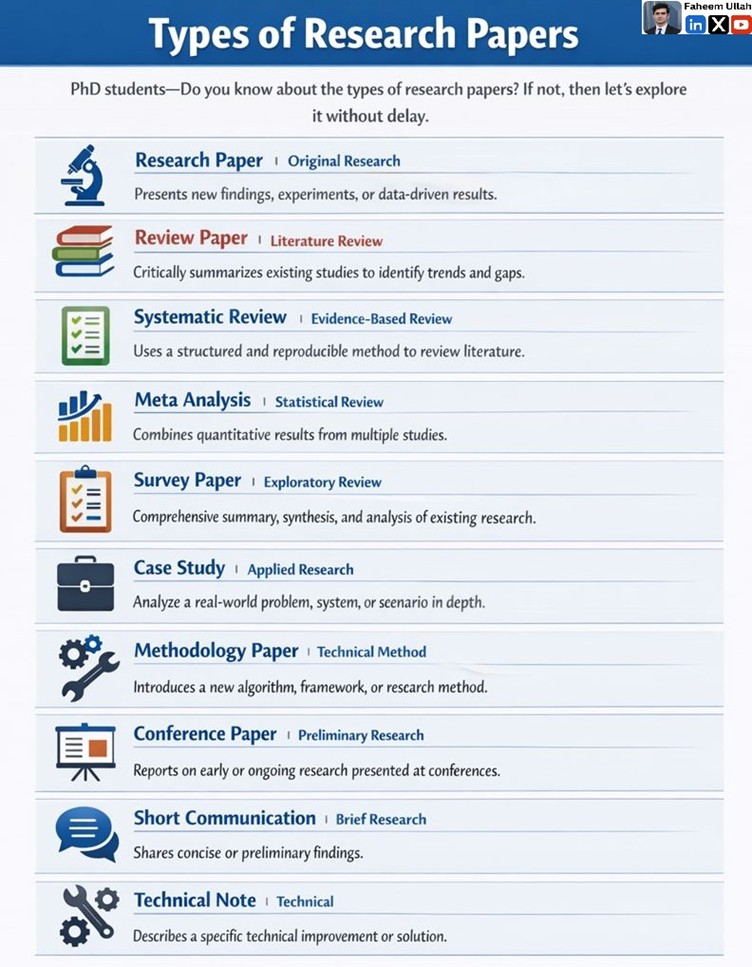
Research Paper (Original Research)
This is the most common research paper.
And the one most PhD students write.
An original research paper presents something new.
New data.
New experiments.
New results.
The core question is simple.
What new knowledge does this study add?
Most thesis chapters eventually become original research papers.
Journals expect clear methodology, strong results, and meaningful discussion.
If your work creates new evidence, this is your primary paper type.
Review Paper (Literature Review)
A review paper does not produce new data.
Instead, it studies existing research.
But it is not just summarizing papers.
A good review paper compares studies.
It highlights trends.
It identifies gaps.
Review papers are powerful.
They shape future research directions.
They are often highly cited.
If you want to deeply understand a field, writing a review paper is a great starting point.

Do you want to automatically create PPT slides for a research paper?
Try Research Bites – a tool that converts a research paper into downloadable PPT slides
Try it here: www.researchbites.com
Systematic Review (Evidence-Based Review)
A systematic review follows a strict method.
Nothing is random.
Databases are selected carefully.
Search terms are fixed.
Inclusion criteria are defined clearly.
This makes the review transparent and reproducible.
Bias is reduced.
Systematic reviews are common in health and social sciences.
They are trusted because readers can trace every step.
When evidence quality matters, this format is preferred.
Meta-Analysis (Statistical Review)
A meta-analysis works with numbers.
Not opinions.
It combines quantitative results from multiple studies.
Statistical techniques are used to calculate overall effects.
This approach answers a deeper question.
How strong is the evidence overall?
Meta-analysis is powerful.
But it requires strong statistical skills.
And high-quality existing studies.
This type of paper is often used to influence policy and practice.
Survey Paper (Exploratory Review)
A survey paper maps an entire research area.
It looks broad rather than deep.
Methods are classified.
Approaches are compared.
Strengths and limitations are discussed.
Survey papers are very common in AI, computer science, and engineering.
They help new researchers understand where the field stands.
Well-written surveys often become cornerstone papers in a domain.
Case Study (Applied Research)
A case study focuses on one real-world situation.
One system.
One organization.
One problem.
The goal is depth.
Not generalization.
Case studies are common in business, education, and information systems.
They explain how and why things happen in real contexts.
If experiments are not possible, case studies are often the best option.
Methodology Paper (Technical Method)
A methodology paper focuses on how research is done.
Not what results were achieved.
It introduces a new algorithm, framework, or research method.
The contribution is technical.
Validation is important.
But innovation lies in the method itself.
This paper type is common in engineering and computer science.
If you design tools or models, this format suits you well.
Conference Paper (Preliminary Research)
Conference papers report early-stage research.
They are short and focused.
These papers often present initial results or proof of concept.
They invite feedback rather than final conclusions.
Conferences are fast.
They help you test ideas.
They help you build visibility.
Many conference papers later become journal papers.
Short Communication (Brief Research)
Some findings are important but limited.
A short communication is perfect in such cases.
It shares concise or preliminary results.
Often time sensitive.
These papers are brief.
But they can be highly impactful.
They allow researchers to publish quickly when speed matters.
Technical Note (Technical)
A technical note focuses on a specific improvement.
It may optimize an existing method.
Or fix a known issue.
The scope is narrow.
But the contribution is clear.
Technical notes are practical and problem-driven.
They attract readers facing similar technical challenges.
Final Thoughts
Understanding research paper types is not optional.
It is a core academic skill.
Choosing the right type improves clarity.
It improves acceptance chances.
It saves months of frustration.
Before writing your next paper, pause for a moment.
Ask yourself what kind of contribution you are making.
Your research deserves the right format.
And the right format helps it reach the right audience.
Until next week,
Keep researching smart.