

One of the most common questions I receive from PhD students and researchers is:
“I have finished my results section. Now what do I write in the discussion section?”
Many people think the discussion section is simply a place to repeat the results. It is not.
The discussion is where you explain what your findings actually mean. It is the part of the paper where you connect your results with previous research, explain why they matter, discuss limitations, and suggest future work.
AI tools of the week:
UPDF : A tool to extract and analyse data for literature reviews

Gatsbi : An AI-powered platform for writing complete literature reviews


CiteDash AI : An AI-powered platform to help you write your thesis.

Think of it this way.
- Results section: What did you find?
- Discussion section: Why do those findings matter?
In this blog, we will walk through a real discussion section (shown in the attached example) and understand exactly how it is written. By the end, you will know the purpose of every paragraph and be able to write your own discussion section with confidence.
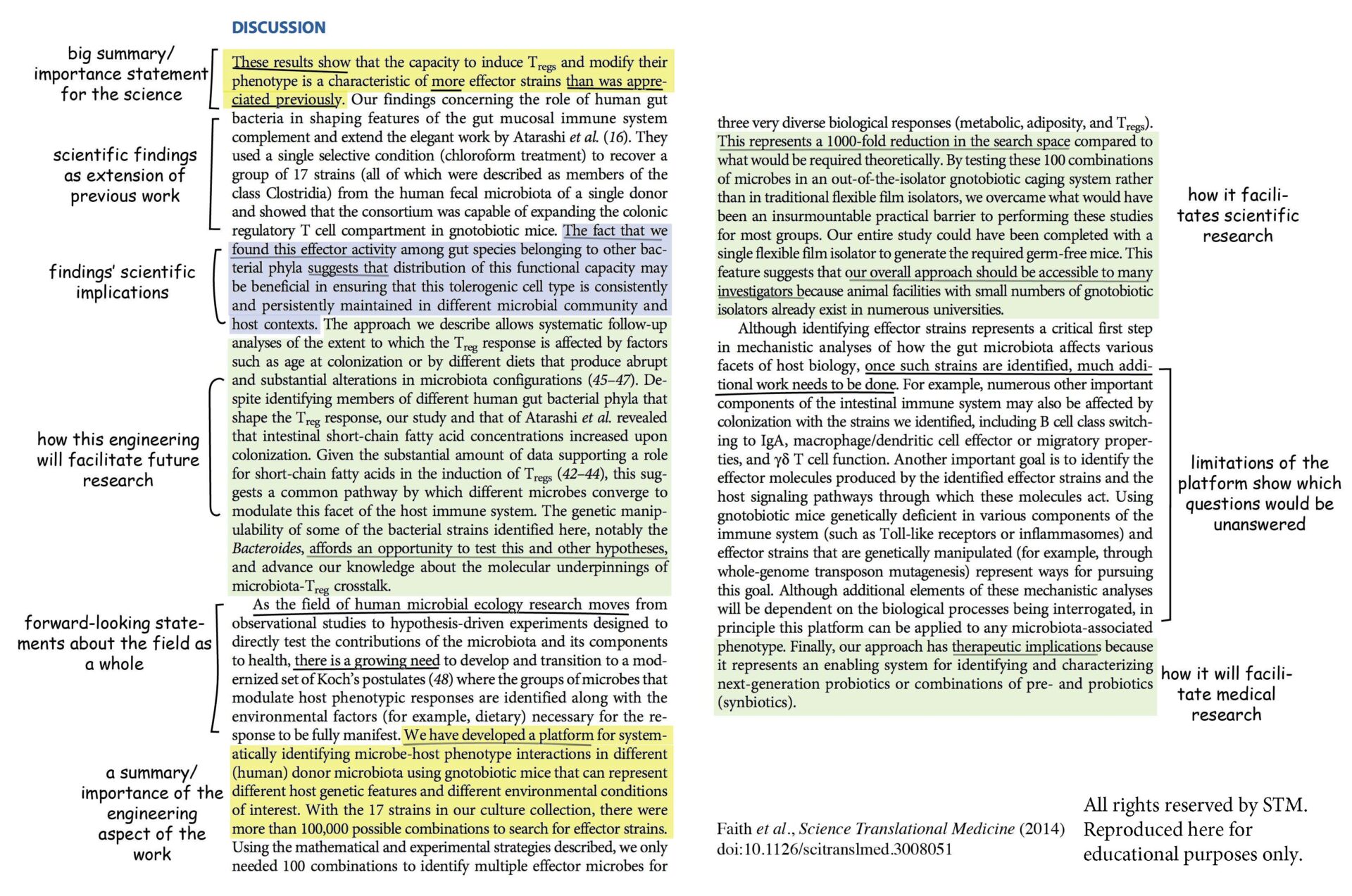
What Is the Discussion Section?
The discussion section is where you interpret your research findings instead of simply presenting numbers or observations.
A good discussion should answer questions such as:
- What do the results mean?
- Were they expected?
- How do they compare with previous studies?
- Why are they important?
- What are the limitations?
- What should future researchers investigate?
The discussion is your opportunity to tell the story behind your results.
The Overall Structure of a Good Discussion
The sample discussion follows a structure that many high-quality journals use.
It moves from:
Summary → Interpretation → Comparison → Implications → Limitations → Future Work → Final Takeaway
Let’s examine each part.
1. Begin with the Main Finding
The discussion opens by immediately reminding readers of the most important result.
Instead of repeating every result from the Results section, the authors focus only on the key discovery.
For example, the discussion begins by explaining that the study identified bacterial strains capable of inducing regulatory T cells.
This immediately tells readers:
“Here is the most important thing our study discovered.”
This opening paragraph acts as a bridge between the Results and Discussion sections.
Good example
“Our findings demonstrate that the proposed model significantly improves prediction accuracy compared to previous approaches.”
Notice that this sentence does not repeat numbers.
It explains the main message.
2. Explain What the Results Mean
After introducing the main finding, the authors explain why it matters.
This is where interpretation begins.
Instead of saying:
We identified 17 bacterial strains.
they explain what that discovery means for biology and why it is important.
This is the biggest difference between the Results and Discussion sections.
The Results section says:
“This happened.”
The Discussion section says:
“This happened because…” or “This is important because…”
Always ask yourself:
What does this finding tell us?
3. Connect Your Findings with Previous Research
One of the strongest features of the sample discussion is that it constantly compares the new findings with earlier studies.
Notice how the authors use phrases like:
- Previous studies showed…
- Our findings extend…
- Consistent with earlier work…
- In contrast to previous reports…
This tells readers that the researchers understand the existing literature.
Research is a conversation.
Your discussion should show how your study contributes to that conversation.
Example
Previous research found that online learning improves student engagement.
Your study found similar results.
Instead of simply stating your findings, write:
“Our findings are consistent with previous studies that reported higher student engagement in online learning environments.”
This immediately strengthens your paper.
4. Explain the Scientific Importance
The sample discussion does not stop after comparing results.
It explains why those findings matter for the wider scientific community.
Ask yourself:
- Does this solve a problem?
- Does this introduce a new method?
- Does it improve existing knowledge?
- Does it challenge previous assumptions?
Readers should understand why your research deserves attention.
Every important finding should answer the question:
“So what?”
If you cannot answer that question, your discussion is probably too descriptive.
5. Discuss Practical Implications
One of the best parts of the sample discussion is that the authors explain how their findings could be used.
They describe how their platform could help future researchers perform systematic studies and identify useful bacterial strains more efficiently.
In other words, they move beyond theory and discuss application.
Depending on your field, practical implications may include:
- Better healthcare
- Improved education
- New software tools
- Better business decisions
- Environmental improvements
- Public policy recommendations
Readers like knowing how research can make a real-world difference.
6. Acknowledge the Limitations
No research study is perfect.
Strong researchers openly discuss the limitations of their work.
Notice that the authors do not hide what their study could not do.
Instead, they explain that additional analyses are still needed before fully understanding the biological mechanisms.
This actually increases the credibility of the paper.
Some common limitations include:
- Small sample size
- Limited geographical area
- Short study duration
- Data availability
- Measurement errors
- Limited variables
You should never pretend your study has no weaknesses.
Being honest makes your research more trustworthy.
7. Suggest Future Research
The discussion naturally leads into future work.
The authors explain what other researchers should investigate next.
This is not simply a list of random ideas.
Each future direction comes directly from the study’s findings.
Good future research suggestions answer questions like:
- What remains unknown?
- What should be tested next?
- Can the study be expanded?
- Can different methods be used?
- Can the research be applied in other settings?
Future work should feel like the next logical step.
8. End with a Strong Closing Statement
The final paragraph leaves readers with the overall contribution of the study.
Instead of repeating results, the authors emphasize the broader value of their platform and explain how it could accelerate future discoveries.
A strong ending reminds readers why the research matters.
For example:
“Overall, our proposed framework provides an efficient and reliable approach that can support future research in this area.”
The final paragraph should leave a lasting impression.
Simple Template You Can Follow
If you are unsure how to write your discussion, use this structure:
Paragraph 1
- State the main finding.
Paragraph 2
- Explain what the finding means.
Paragraph 3
- Compare with previous studies.
Paragraph 4
- Explain scientific and practical significance.
Paragraph 5
- Discuss limitations.
Paragraph 6
- Suggest future research.
Paragraph 7
- End with the overall contribution of the study.
Following this structure makes your discussion clear, logical, and easy to read.
Common Mistakes to Avoid
Many researchers struggle with the discussion section because they make a few common mistakes.
Avoid these pitfalls:
- Repeating the Results section word for word.
- Introducing completely new results that were never presented earlier.
- Ignoring previous research.
- Making claims that are not supported by the data.
- Forgetting to discuss limitations.
- Ending the discussion without explaining the overall contribution.
- Writing vague future research suggestions that are unrelated to the study.
A good discussion explains, interprets, and connects. It does not simply describe.
Final Thoughts
The discussion section is where your research truly comes to life. It transforms a list of results into a meaningful scientific story by explaining what your findings mean, how they relate to previous work, why they matter, and what should happen next.
The sample discussion we examined follows a simple but highly effective flow. It starts with the main finding, interprets the results, connects them to existing literature, highlights their scientific and practical value, acknowledges limitations, suggests future research, and finishes with a strong conclusion.
If you use this structure in your own papers, your discussion will be much clearer, more persuasive, and easier for reviewers and readers to follow.
Remember this simple rule:
The Results section tells readers what you found. The Discussion section tells them why they should care.
Dear Dr. Faheem,
Thank you so much, credible insight how to structure the Discussion section and also the logical integration with the Results section as well as the techniques to move towards the Future Recommendations, furthermore, the overall coherence with the structure of a dissertation.