If you have just started your PhD or are planning a research project, you have probably heard the term systematic literature review (SLR) many times. It is one of the most respected research methods because it provides a structured and reliable way to answer a research question using existing evidence.
AI tools of the week:
Mira : An all-in-one platform for conducting top quality research.

CiteDash AI : An AI-powered platform to help you write your thesis.

ResearchCollab : An AI tool for literature reviews and identifying research gaps.

Thesify : An AI tool to receive feedback on your thesis before submission.

Unlike a traditional literature review, a systematic literature review follows a clear, transparent, and repeatable process. Every step is carefully planned so that personal opinions or biases do not influence the findings.
In this guide, you will learn what a systematic literature review is, why it is important, and how you can conduct one step by step.
What Is a Systematic Literature Review?
A systematic literature review is a research method that collects, evaluates, and summarizes all available evidence related to a specific research question using a predefined and transparent process.
Instead of reading random papers and selecting only the ones you like, a systematic review follows strict rules about:
- Where to search
- Which studies to include
- Which studies to exclude
- How to evaluate study quality
- How to summarize the findings
The goal is simple: find all relevant evidence and minimize bias.
Think of it like solving a puzzle. Rather than looking at only a few pieces, you gather every available piece before trying to see the complete picture.
Systematic Review vs Traditional Literature Review
Many students confuse these two types of reviews.
A traditional literature review usually provides a broad overview of a topic. The author chooses studies that appear relevant and discusses them based on experience or judgment.
A systematic literature review is much more structured. Every decision is documented and justified. Another researcher following the same process should be able to obtain very similar results.
In simple words:
Traditional Review: Flexible and narrative.
Systematic Review: Structured, transparent, and reproducible.
That is why systematic reviews are considered one of the highest levels of scientific evidence in many disciplines, especially medicine, healthcare, psychology, education, engineering, and computer science.s, knows the important researchers, and can help you avoid common mistakes. They can also connect you with valuable collaborators and research opportunities.
Why Is a Systematic Literature Review Important?
A systematic literature review offers many benefits for researchers.
1. It Provides Reliable Evidence
Instead of relying on one or two studies, systematic reviews combine findings from many high-quality studies. This leads to more trustworthy conclusions.
2. It Reduces Bias
Researchers often have unconscious preferences when selecting papers. A systematic review minimizes this problem by using predefined selection criteria.
3. It Identifies Research Gaps
By reviewing all available evidence, you can clearly see which questions have already been answered and which areas still need further investigation.
Many successful PhD topics begin with a systematic literature review because it highlights opportunities for new research.
4. It Saves Future Researchers Time
Rather than reading hundreds of individual papers, future researchers can use a systematic review as a reliable summary of the current state of knowledge.
5. It Supports Evidence-Based Decisions
Governments, healthcare professionals, businesses, and policymakers often rely on systematic reviews when making important decisions because they provide a comprehensive overview of the available evidence.
When Should You Conduct a Systematic Literature Review?
A systematic review is useful when:
- You want to answer a focused research question.
- The topic already has many published studies.
- You want to summarize existing evidence.
- You want to identify research gaps.
- You are writing a PhD thesis or journal paper.
- You are preparing evidence for policy or clinical practice.
However, if your goal is simply to introduce a topic or provide background information, a traditional literature review may be more appropriate
How to Conduct a Systematic Literature Review
Although different guidelines exist, most systematic reviews follow a similar process.
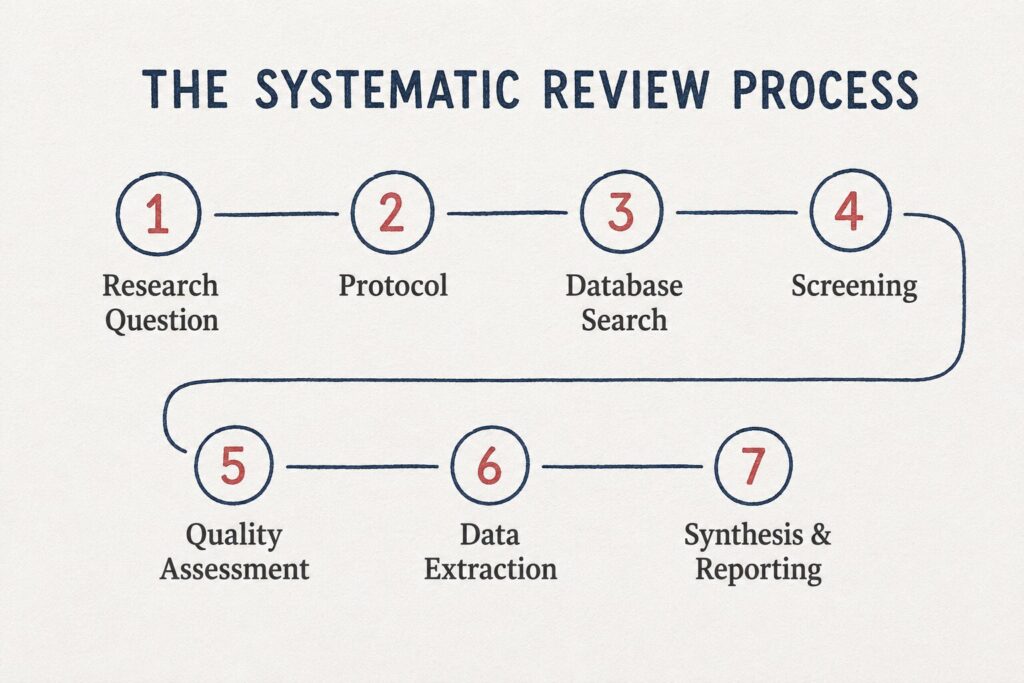
Step 1: Define a Clear Research Question
Everything begins with a well-defined research question.
Instead of asking:
“How does artificial intelligence affect healthcare?”
Ask something more focused:
“How does artificial intelligence improve early cancer diagnosis?”
A focused question makes the entire review easier to conduct.
Step 2: Develop a Review Protocol
Before searching for studies, prepare a protocol that explains exactly how the review will be conducted.
This usually includes:
- Research objectives
- Search strategy
- Databases to search
- Keywords
- Inclusion criteria
- Exclusion criteria
- Quality assessment methods
- Data extraction process
Creating a protocol before starting helps reduce bias and keeps the review organized.
Step 3: Search the Literature
Search multiple academic databases instead of relying on only one source.
Common databases include:
- Google Scholar
- Scopus
- Web of Science
- PubMed
- IEEE Xplore
- ACM Digital Library
- ScienceDirect
Use combinations of keywords and Boolean operators such as AND, OR, and NOT to improve your search results.
A good search strategy ensures that important studies are not missed.
Step 4: Screen the Studies
After collecting the search results, remove duplicate papers.
Then screen the remaining studies in two stages:
First: Read titles and abstracts.
Second: Read the full text of potentially relevant papers.
Exclude studies that do not meet your predefined criteria.
Many researchers use the PRISMA flow diagram to document this selection process.
Step 5: Assess Study Quality
Not every published paper has the same quality.
Evaluate each study using appropriate quality assessment tools.
Consider questions such as:
- Was the research design appropriate?
- Was the sample size adequate?
- Were the methods clearly described?
- Are the conclusions supported by the results?
Only high-quality studies should strongly influence your final conclusions.
Step 6: Extract the Data
Create a spreadsheet to record important information from every included study.
Common information includes:
- Authors
- Publication year
- Country
- Research objective
- Methodology
- Sample size
- Main findings
- Limitations
A structured data extraction table makes later analysis much easier.
Step 7: Analyze and Synthesize the Findings
Now combine the evidence from all included studies.
Look for:
- Common findings
- Differences between studies
- Emerging trends
- Research gaps
- Areas of disagreement
If the studies contain numerical results that can be statistically combined, you may perform a meta-analysis. Otherwise, most systematic reviews use a narrative synthesis to explain the findings.
Step 8: Report the Results
Finally, write the review in a clear and transparent way.
A typical systematic literature review includes:
- Introduction
- Research question
- Methodology
- Search strategy
- Study selection process
- Quality assessment
- Results
- Discussion
- Limitations
- Conclusion
Be sure to describe every step so that other researchers can understand and reproduce your work.
Common Mistakes to Avoid
Many beginners make avoidable mistakes when conducting systematic reviews.
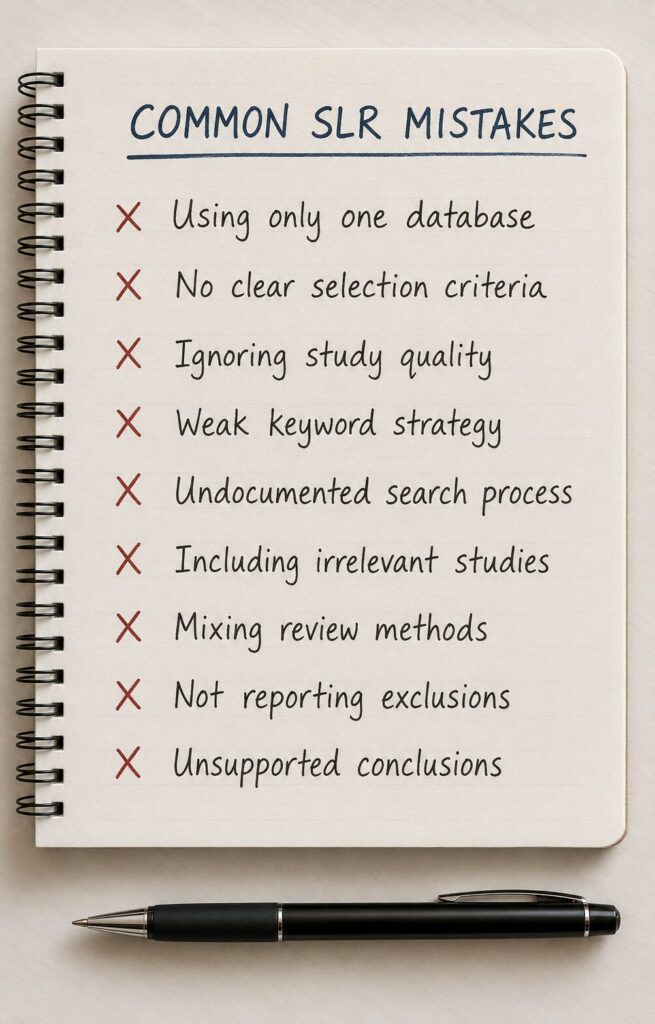
Some of the most common include:
- Using only one database
- Choosing studies without clear criteria
- Ignoring study quality
- Missing important keywords
- Failing to document the search strategy
- Including outdated or irrelevant studies
- Mixing systematic and narrative review methods
- Not reporting excluded studies
- Drawing conclusions that are not supported by the evidence
Avoiding these mistakes will greatly improve the quality and credibility of your review.
AI Tools Can Make the Process Faster
Today, AI tools can significantly reduce the time needed to conduct a systematic literature review.
Many tools can help you:
- Generate search keywords
- Discover relevant papers
- Remove duplicate studies
- Screen abstracts faster
- Summarize research articles
- Extract key findings
- Organize references
- Identify research gaps
However, AI should assist your work rather than replace your judgment. You are still responsible for evaluating study quality, interpreting findings, and ensuring the review follows accepted scientific standards.
Final Thoughts
A systematic literature review is much more than a collection of research papers. It is a structured and transparent process for identifying, evaluating, and synthesizing the best available evidence on a specific research question.
Although conducting a systematic review takes time and careful planning, the effort is worthwhile. A well-executed review provides reliable evidence, uncovers research gaps, strengthens future research, and supports evidence-based decision-making.
Whether you are a PhD student, an early-career researcher, or an experienced academic, learning how to conduct a systematic literature review is one of the most valuable research skills you can develop. By following a clear methodology, documenting every step, and critically evaluating the evidence, you can produce a review that not only advances your own research but also becomes a valuable resource for the wider scientific community.