Are you working hard on your PhD but making little progress? Discover 10 warning signs that your PhD research may be going in the wrong direction and learn practical ways to get back on track.
A PhD is one of the most challenging academic journeys. You spend years reading research papers, conducting experiments, analyzing data, and trying to contribute new knowledge to your field.
But what if you are working hard and still not making meaningful progress?
You might be reading dozens of papers without identifying a research gap. You might be conducting experiments that produce results but do not answer your research questions. Or you might be spending months on activities that contribute very little to your thesis.
The biggest mistake is assuming that being busy means making progress.
Research rarely follows a straight path. Failed experiments, unexpected findings, and periods of uncertainty are normal. However, repeatedly working without a clear direction can waste valuable time.
AI tools of the week:
ResearchCollab : An all-in-one platform for automating research tasks

Gatsbi : A tool for writing fully cited literature reviews.

Thesify : An AI-powered platform for research thesis evaluation

Rectoly : The ultimate iPad, Windows and Mac reader Mendeley users have been waiting for.

Here are 10 warning signs your PhD research may be going in the wrong direction, along with practical solutions to help you move forward.
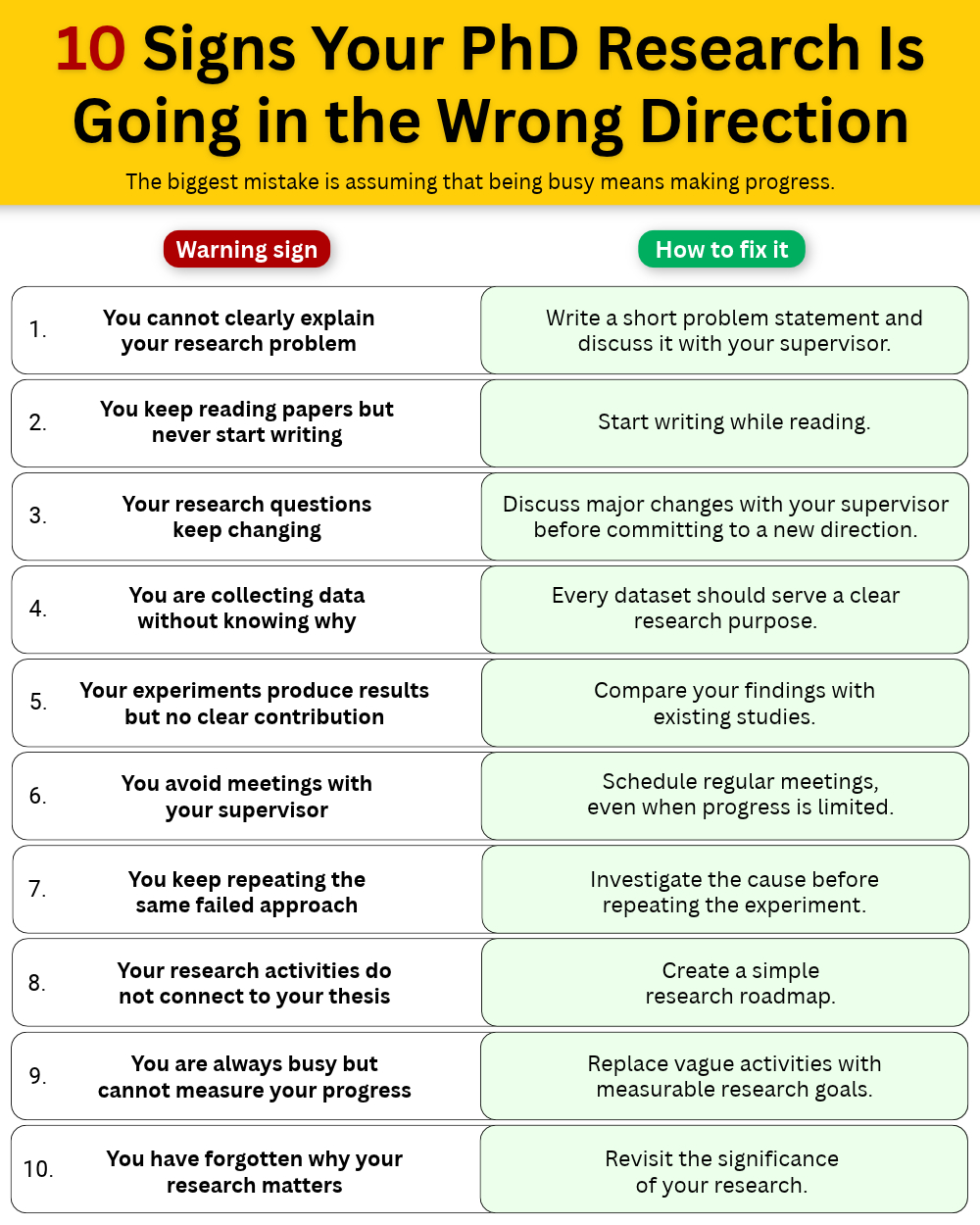
1. You Cannot Clearly Explain Your Research Problem
Imagine someone asking you, “What problem are you trying to solve in your PhD?”
If you struggle to provide a clear answer, your research problem may not be sufficiently defined.
Many PhD students understand their general research area but cannot identify the specific problem they are investigating.
For example:
Too broad: “My research focuses on artificial intelligence in healthcare.”
More specific: “My research investigates how machine learning can improve disease detection when limited training data is available.”
The second statement identifies a clearer research problem.
How to fix it:
Try answering three questions:
- What specific problem am I investigating?
- Why is this problem important?
- What is missing from existing research?
Write a short problem statement using these answers and discuss it with your supervisor.
A clearly defined research problem helps you develop focused research questions, select appropriate methods, and explain the importance of your study.
2. You Keep Reading Papers but Never Start Writing
Does this sound familiar?
You download 20 papers, read five, discover another ten, and repeat the process.
Weeks become months, but your literature review remains unfinished.
Many PhD students believe they must read everything before writing. Unfortunately, there will always be another relevant paper.
The purpose of a literature review is not to collect hundreds of references. It is to understand existing knowledge, compare findings, and identify meaningful research gaps.
How to fix it:
Start writing while reading.
After reviewing several related papers, summarize what researchers agree on, where their findings differ, and which questions remain unanswered.
For example, instead of writing separate summaries of ten machine learning studies, compare their methods, datasets, results, and limitations.
Organize your literature review around research themes rather than individual authors.
Remember: Reading more papers does not automatically mean understanding your research problem better.
3. Your Research Questions Keep Changing
Research questions often evolve during a PhD. New findings may reveal unexpected problems or better research opportunities.
However, constantly changing your research questions without a clear reason can create confusion.
For example, you may begin by investigating cybersecurity vulnerabilities, then switch to AI model performance, and later focus on data privacy.
Although these topics are related, they may require different methodologies, datasets, and research objectives.
Frequent changes can make it difficult to develop a coherent thesis.
How to fix it:
Before changing your research questions, ask:
- What evidence justifies this change?
- Does the new question address my original research problem?
- Can I realistically investigate it within my remaining time?
Discuss major changes with your supervisor before committing to a new direction.
Refining research questions is part of scientific research. However, every significant change should have a clear justification.
4. You Are Collecting Data Without Knowing Why
Collecting data can make you feel productive.
You might spend weeks conducting surveys, interviewing participants, downloading datasets, or running experiments.
But what happens if the collected data cannot answer your research questions?
For example, imagine collecting thousands of social media posts to study public attitudes toward AI without deciding which attitudes to investigate or how to analyze them.
You may end up with a large dataset but very little useful evidence.
How to fix it:
Before collecting data, connect each research question to the information you need.
| Research question | Required data | Analysis method |
| What influences AI adoption? | Survey responses | Statistical analysis |
| What challenges do users face? | Interviews | Thematic analysis |
| How accurate is a prediction model? | Labeled dataset | Model evaluation |
Every dataset should serve a clear research purpose.
Before starting data collection, ask yourself: “How will this data help me answer my research question?”
5. Your Experiments Produce Results but No Clear Contribution
Imagine developing a machine learning model that achieves 95% accuracy.
You are excited about the result.
But then you discover that existing approaches already achieve similar or better performance.
What does your research contribute?
Producing experimental results is not necessarily the same as making a scientific contribution.
A PhD should advance knowledge through an original contribution appropriate to its field.
How to fix it:
Compare your findings with existing studies.
Ask yourself:
- What new knowledge does my research provide?
- How does my approach differ from previous work?
- What limitation does it address?
- Why should other researchers care about these findings?
Remember that scientific contributions are not limited to improved performance.
Your research might introduce a new method, explain an existing problem, challenge previous findings, or provide evidence in an unexplored context.
A strong PhD contribution explains what we know now that we did not know before.
6. You Avoid Meetings With Your Supervisor
Many PhD students avoid supervisor meetings when they feel their research is not progressing.
They may think:
“I haven’t achieved anything significant.”
“My supervisor will be disappointed.”
“I should complete another experiment before scheduling a meeting.”
Unfortunately, avoiding supervision can make research problems worse.
A methodological issue that could have been resolved through a short discussion may remain unresolved for months.
How to fix it:
Schedule regular meetings, even when progress is limited.
Prepare a short update explaining what you completed, what you learned, which challenges you encountered, and where you need guidance.
Be open about unsuccessful experiments and unexpected findings.
If your supervisory relationship is consistently difficult, consider seeking guidance from a co-supervisor or graduate coordinator.
Remember that supervision is not only about reporting achievements. It is also about identifying problems and making better research decisions.
7. You Keep Repeating the Same Failed Approach
Failure is a normal part of scientific research.
Your experiments may not produce expected results. Your proposed model may perform poorly. Your initial assumptions may turn out to be incorrect.
These experiences can provide valuable insights.
However, repeating the same unsuccessful approach without investigating why it fails can waste months.
For example, a PhD student may repeatedly adjust machine learning hyperparameters when the real problem is poor data quality.
How to fix it:
When an experiment fails, investigate the cause before repeating it.
Ask whether your assumptions, dataset, methodology, or evaluation metrics are appropriate.
Maintain a research log documenting what you tested, what happened, and what you learned.
Before conducting another experiment, identify what you will change and why.
Failed experiments are not necessarily wasted effort. Repeating them without learning can be.
8. Your Research Activities Do Not Connect to Your Thesis
A PhD thesis should present a coherent body of research.
However, some students become involved in multiple projects that do not clearly contribute to their main research objectives.
For example, a student researching AI-based cybersecurity might publish papers on intrusion detection, medical image classification, and social media sentiment analysis.
Although all three involve artificial intelligence, they may not form a coherent thesis.
Publishing several papers does not automatically mean you are progressing toward your PhD.
How to fix it:
Create a simple research roadmap.
Identify your main research problem and divide it into connected objectives.
For example, if your research focuses on AI-based intrusion detection, your objectives might involve identifying limitations of existing methods, developing an improved approach, and evaluating its reliability.
Now examine your current activities.
Do they contribute to these objectives?
Not every academic activity must become part of your thesis, but your main research efforts should support your doctoral goals.
9. You Are Always Busy but Cannot Measure Your Progress
Many PhD students work long hours but struggle to identify what they have achieved.
Their days involve reading emails, attending meetings, searching for papers, organizing references, and adjusting experiments.
These activities can be necessary, but they do not always produce meaningful progress.
Ask yourself:
“What have I completed in the last three months that brings me closer to finishing my PhD?”
If you cannot identify clear outcomes, your priorities may need attention.
How to fix it:
Replace vague activities with measurable research goals.
Instead of writing “Work on literature review,” set a goal such as “Compare 15 relevant studies and complete the methodology comparison section.”
Instead of “Improve the model,” write “Evaluate three baseline models and document their performance.”
Track completed analyses, written chapters, resolved research questions, and important research decisions.
Research progress is not always linear, but clear milestones can help you recognize whether your work is moving forward.
10. You Have Forgotten Why Your Research Matters
After years of experiments, deadlines, revisions, and academic pressure, it is possible to lose sight of the purpose of your research.
You may become focused on publishing papers, improving performance metrics, or completing technical tasks without considering the bigger research problem.
For example, a researcher developing AI models for healthcare may focus entirely on improving accuracy while overlooking whether the models address a meaningful clinical challenge.
How to fix it:
Revisit the significance of your research.
Ask yourself:
- Why is this problem worth investigating?
- What new knowledge will my research provide?
- Who could benefit from the findings?
- What would remain unknown without this study?
Not every PhD must produce an immediate practical solution. Theoretical contributions, methodological improvements, and reliable scientific evidence can also be valuable.
The important thing is understanding why your research matters.
How to Get Your PhD Research Back on Track
If you recognize several of these warning signs, it does not mean your PhD is failing.
It means you may need to review your research direction.
Here are five practical steps:
Step 1: Revisit your research problem: Clearly define what you are investigating and why it matters.
Step 2: Review your research questions: Make sure they are specific, feasible, and aligned with your research objectives.
Step 3: Evaluate your current progress: Identify which experiments, analyses, and activities have produced useful evidence.
Step 4: Discuss your concerns with your supervisor: Share the problems you have identified and explore possible solutions.
Step 5: Create a realistic action plan: Set two or three achievable milestones for the next month and review your progress regularly.
The goal is not to change your research direction every time you encounter difficulties. It is to make informed decisions based on evidence and academic guidance.
Frequently Asked Questions
Is it normal to feel lost during a PhD?
Yes. Uncertainty is a normal part of scientific research. Many PhD students experience periods when their direction feels unclear. However, persistent confusion about your research questions or methodology should be discussed with your supervisor.
How do I know if my PhD topic is too broad?
Your topic may be too broad if you cannot identify a specific research problem, develop focused research questions, or design a feasible methodology within your available time and resources.
Does slow PhD progress mean my research is failing?
Not necessarily. Some research problems require extended exploration, and unexpected results can still provide valuable knowledge. The important question is whether your work is helping you understand and address your research problem.
Final Thoughts
A PhD journey is rarely a straight path.
There will be failed experiments, rejected papers, unexpected findings, and moments when you question your research direction.
These experiences do not automatically mean you are doing something wrong.
However, repeatedly ignoring warning signs can lead to unnecessary delays and wasted effort.
Before starting another experiment or downloading another research paper, ask yourself:
“Am I making meaningful progress toward answering my research questions, or am I simply staying busy?”
Remember that a successful PhD is not about doing more research. It is about doing research that contributes meaningful knowledge.
Sometimes, the smartest decision you can make is to reconsider an unproductive approach, learn from the evidence, and choose a better direction.
Recognizing that early can save months of unnecessary work.