

What makes a research paper good? Is it the number of pages, the number of references, or the journal in which it is published?
The answer is none of these alone.
AI tools of the week:
Sourcely : Find scientific sources for your papers in seconds.

Rectoly : The ultimate iPad, Windows and Mac reader Mendeley users have been waiting for.

ResearchCollab : An all-in-one platform for researchers to 10x research productivity.

Yomu AI : An AI-powered tool for writing research papers.

A research paper can be 30 pages long, include 100 references, and still fail to make a meaningful contribution. On the other hand, a shorter paper with a clear research question, strong methodology, and useful findings can have a significant impact.
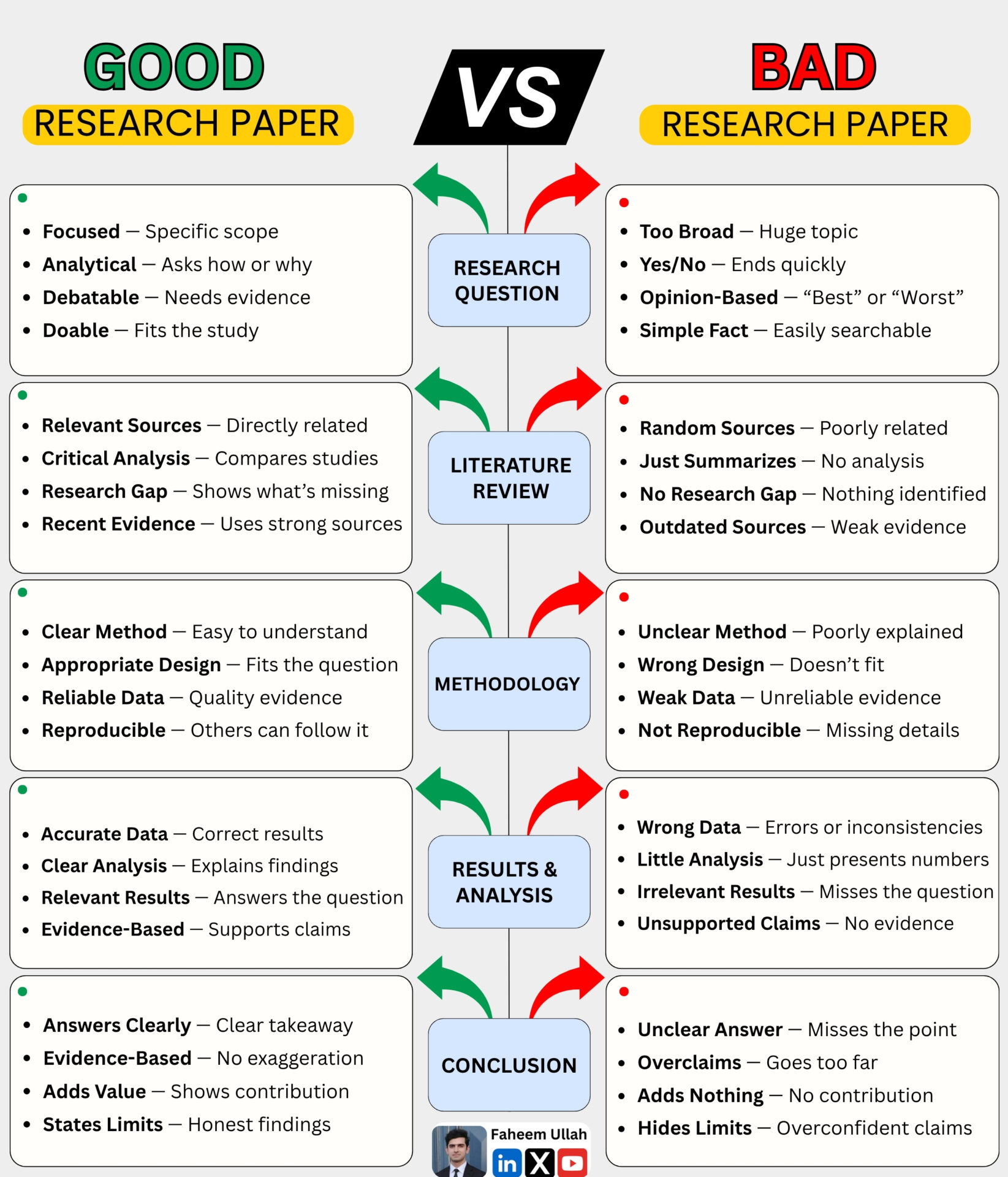
The difference between a good research paper and a bad research paper is not always obvious, especially for PhD students and early-career researchers.
A good research paper tells a clear story. It identifies an important problem, examines existing knowledge, follows a reliable method, presents meaningful results, and explains why those results matter.
A bad research paper often struggles with one or more of these steps.
In this blog, we will explore five key differences between good and bad research papers, with practical examples and tips to improve your academic writing.
1. Research Question: Focused vs Too Broad
Every good research paper starts with a strong research question.
Your research question determines what you will investigate, which methods you will use, and what results you expect to produce.
A good research question is:
- Focused: It addresses a specific problem rather than a huge topic.
- Analytical: It asks how or why something happens.
- Debatable: It requires evidence and investigation.
- Doable: It can be answered with the available time, resources, and data.
A bad research question is:
- Too broad: It covers too many problems.
- Yes/No based: It can be answered without much investigation.
- Opinion-based: It asks what is best or worst without clear criteria.
- A simple fact: The answer can easily be found through a basic search.
Example
Bad research question:
“Is artificial intelligence good for education?”
This question is too broad. It does not specify which AI technologies, which students, or which educational outcomes.
Good research question:
“How does the use of AI writing assistants affect the academic writing skills of undergraduate students?”
This question is more focused, measurable, and suitable for scientific investigation.
Practical tip: Before starting your research, ask yourself: Can I answer this question using evidence? Is it specific enough? Does it address something worth investigating?
A clear research question makes every other part of your paper easier.
2. Literature Review: Critical Analysis vs Simple Summary
The literature review is one of the most important sections of a research paper.
Unfortunately, many researchers treat it as a place to summarize previously published studies.
They write something like:
“Smith (2021) studied artificial intelligence in education. Jones (2022) investigated machine learning. Brown (2023) examined AI tools.”
Although these statements describe previous studies, they do not explain how the studies relate to one another or what is still missing.
A good literature review:
- Uses relevant studies directly related to the research question.
- Critically compares previous findings and approaches.
- Identifies limitations, disagreements, and research gaps.
- Uses credible and recent evidence where appropriate.
A bad literature review:
- Includes random or poorly related references.
- Simply summarizes one study after another.
- Fails to identify a meaningful research gap.
- Relies on outdated or weak sources without justification.
Example
Bad literature review:
“Several researchers have investigated AI tools in education. Smith (2022) studied ChatGPT, while Jones (2023) investigated automated writing systems.”
Good literature review:
“Previous studies suggest that AI writing tools can improve writing efficiency. However, most studies have focused on short-term productivity, while their long-term effects on students’ independent writing skills remain less understood.”
Notice the difference?
The second example connects previous findings, identifies what is missing, and creates a clear reason for conducting new research.
Practical tip: Do not just explain what previous researchers did. Explain what they found, how their findings compare, what limitations exist, and how your research will contribute.
A strong literature review should lead naturally to your research question.
3. Methodology: Clear and Reproducible vs Confusing and Weak
Imagine reading a research paper that claims a new machine learning model achieves 95% accuracy.
Sounds impressive, right?
But what if the authors do not explain which dataset they used, how they trained the model, or how they calculated accuracy?
Would you trust the results?
Probably not.
This is why methodology matters.
The methodology section explains how the research was conducted and allows readers to evaluate the reliability of the findings.
A good methodology:
- Clear method: Explains each important step.
- Appropriate design: Uses methods suitable for the research question.
- Reliable data: Uses relevant, trustworthy, and properly collected data.
- Reproducible: Provides enough information for other researchers to repeat the study, where feasible.
A bad methodology:
- Unclear method: Leaves important steps unexplained.
- Wrong design: Uses techniques unsuitable for the problem.
- Weak data: Relies on unreliable, biased, or insufficient evidence.
- Not reproducible: Omits important experimental details.
Example
Bad methodology:
“We collected student data and applied machine learning algorithms to predict academic performance.”
This explanation leaves many questions unanswered.
How many students? What data? Which algorithms? How was performance measured?
Good methodology:
“We collected anonymized academic records from 500 undergraduate students. We trained random forest and logistic regression models using attendance, previous grades, and assessment scores. We evaluated both models on a held-out test set using accuracy, precision, recall, and F1-score.”
The second example gives readers a much clearer understanding of the research process, although a complete methodology would need further details.
Practical tip: Write your methodology as if another researcher will try to reproduce your work.
If important steps are missing, your methodology needs improvement.
4. Results and Analysis: Meaningful Findings vs Unsupported Claims
Many early-career researchers make a common mistake.
They believe that presenting tables, graphs, and numbers is enough to write a strong results section.
But results are not the same as analysis.
A good research paper does more than report what happened. It explains what the findings mean and how they relate to the research question.
Good results and analysis include:
- Accurate data: Results are calculated and reported correctly.
- Clear analysis: Findings are properly interpreted.
- Relevant results: Evidence directly addresses the research question.
- Evidence-based claims: Conclusions are supported by the data.
Bad results and analysis include:
- Wrong data: Errors, inconsistencies, or incorrect calculations.
- Little analysis: Numbers are presented without interpretation.
- Irrelevant results: Findings do not address the research question.
- Unsupported claims: Statements go beyond the available evidence.
Example
Bad results and analysis:
“Our proposed model achieved 92% accuracy. Therefore, it is the best model for predicting student performance.”
This is a weak claim.
Why is 92% good? How does it compare with existing models? Was the test dataset representative?
Good results and analysis:
“Our proposed model achieved 92% accuracy, compared with 86% for the baseline model on the same test dataset. The improvement suggests that the proposed approach may provide better predictions under the evaluated conditions. However, further testing on independent datasets is needed.”
The second example provides context, comparison, and a reasonable interpretation without making exaggerated claims.
Practical tip: For every important result, ask three questions:
- What did I find?
- Why does this finding matter?
- How does it compare with previous research?
Answering these questions will make your analysis more meaningful.
5. Conclusion: Clear Contribution vs Overclaiming
The conclusion is your final opportunity to explain the value of your research.
Unfortunately, some researchers use this section to repeat their abstract or make claims that their results cannot support.
A good conclusion should leave readers with a clear understanding of what was discovered and why it matters.
A good conclusion:
- Answers clearly: Addresses the original research question.
- Evidence-based: Makes claims supported by the findings.
- Adds value: Explains the contribution to existing knowledge.
- States limitations: Honestly discusses the boundaries of the study.
A bad conclusion:
- Unclear answer: Fails to address the main research question.
- Overclaims: Makes exaggerated statements.
- Adds nothing: Does not explain the research contribution.
- Hides limitations: Presents the research as perfect.
Example
Bad conclusion:
“Our proposed AI model is the best solution for predicting academic performance and can be used by all universities worldwide.”
This statement is too strong unless the research provides substantial evidence to support it.
Good conclusion:
“Our study demonstrates that machine learning can support the prediction of undergraduate academic performance using historical academic records. The proposed model outperformed the selected baseline under the evaluated conditions. However, the study was limited to data from one institution, and further validation is needed before applying the model more widely.”
The second conclusion is more realistic, evidence-based, and scientifically responsible.
Practical tip: Never claim more than your evidence supports. Acknowledging limitations does not make your research weak. It demonstrates scientific honesty.
Quick Checklist: Is Your Research Paper Good Enough?
Before submitting your next research paper, review these ten questions:
- Is my research question clear, focused, and answerable?
- Does my paper address a meaningful research problem?
- Have I critically analyzed previous studies instead of simply summarizing them?
- Have I clearly identified the research gap?
- Is my methodology appropriate and sufficiently explained?
- Are my data and research procedures reliable?
- Do my results directly answer the research question?
- Have I interpreted my findings rather than just reporting numbers?
- Are my conclusions supported by evidence?
- Have I clearly explained my contribution and limitations?
If you can confidently answer yes to these questions, your paper is likely on the right track.
Of course, these are not the only factors that determine research quality. Originality, ethical practices, transparency, and clear writing also matter.
Final Thoughts: A Good Research Paper Is Not Necessarily a Complicated Paper
One of the biggest misconceptions in academic writing is that a good research paper must use complicated language, advanced statistical techniques, or highly sophisticated models.
That is not always true.
A paper that uses a simple but appropriate methodology to answer an important research question can be more valuable than one that uses advanced techniques without a clear purpose.
Remember these five principles:
A good research paper asks a focused question, critically reviews existing knowledge, uses a reliable methodology, presents meaningful evidence, and reaches an honest conclusion.
You do not need to make your research sound complicated to make it impressive.
You need to make it clear, rigorous, and useful.
The goal of research is not simply to publish a paper. It is to contribute something meaningful to existing knowledge.
And that is what separates a good research paper from a bad one.
Dear Dr. Faheem,
Thank you so much.