You have finally completed your PhD.
After years of reading papers, conducting experiments, collecting data, dealing with reviewer comments, attending conferences, and writing your thesis, you have earned the title Dr.
Then comes another difficult question:
What should I do after my PhD?
AI tools of the week:
Rectoly : The ultimate iPad, Windows and Mac reader Mendeley users have been waiting for.

Gatsbi : Get your complete literature review in 10 minutes.

Ponder : A tool for research brainstorming and identifying gaps.

Citely : A tool for identifying relevant citations for your research paper.

PhD → Postdoc → Assistant Professor → Professor
But this is only one of many possibilities.
A PhD teaches you much more than how to conduct research. During your PhD, you develop skills in problem-solving, critical thinking, data analysis, communication, project management, independent learning, and handling complex problems.
These skills are valuable in universities, companies, governments, startups, research organizations, consulting firms, and many other places.
If you are wondering about your career options after a PhD, here are 10 career paths worth exploring.
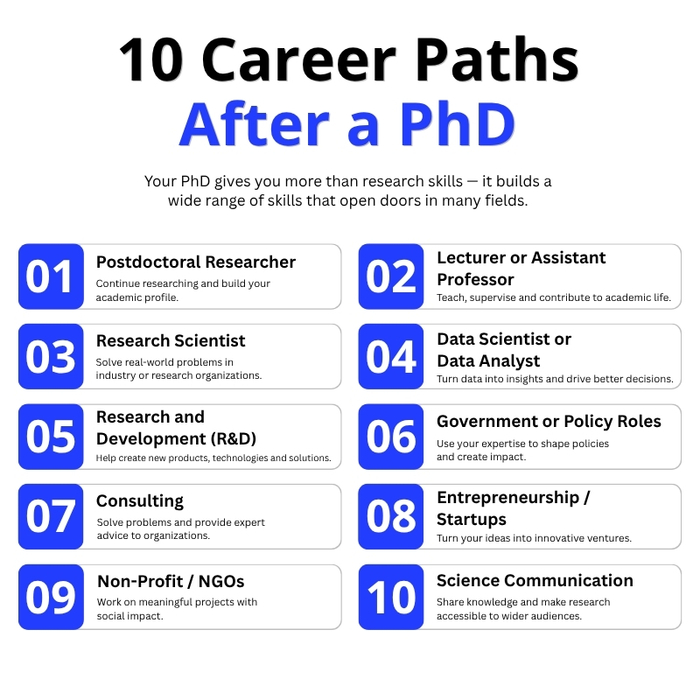
1. Postdoctoral Researcher
One of the most common paths immediately after completing a PhD is becoming a postdoctoral researcher, commonly called a postdoc.
A postdoc allows you to continue conducting research, usually under the supervision or leadership of a senior researcher.
During a postdoc, you may:
- Publish research papers
- Develop new research projects
- Apply for research funding
- Supervise students
- Build collaborations
- Attend conferences
- Develop specialized research expertise
A postdoc can be particularly useful if your long-term goal is to build an academic or research career.
However, postdoctoral positions are usually temporary. Before accepting one, think about what it will add to your CV and where you want it to take you next.
Best suited for: PhDs who enjoy research and want to strengthen their academic profile.
2. Lecturer or Assistant Professor
If you enjoy both teaching and research, an academic position may be a natural choice.
Depending on the country and university system, your first academic position might be called Lecturer, Assistant Professor, Research Fellow, or something similar.
As an academic, your responsibilities may include teaching students, supervising research projects, publishing papers, applying for research grants, serving on university committees, and working with industry or other universities.
One thing new PhDs sometimes underestimate is that being a professor is not simply about conducting research.
Academic jobs can involve a significant amount of teaching, administration, student supervision, grant writing, and service in addition to research.
Best suited for: PhDs who enjoy research, teaching, mentoring, and university life.
3. Research Scientist
You don’t have to work at a university to continue doing research.
Many companies employ research scientists to solve complex problems and develop new technologies, products, processes, and services.
For example, PhDs in artificial intelligence, computer science, engineering, biotechnology, pharmaceuticals, chemistry, and other technical fields can find research roles in industry.
The main difference is often the objective.
Academic research may focus heavily on producing new knowledge and publications, while industrial research is usually connected more directly to organizational goals, products, customers, or technologies.
Best suited for: PhDs who love research but prefer an industry environment.
4. Data Scientist or Data Analyst
A PhD often involves working with data.
You may have collected data, cleaned it, analyzed it, visualized it, interpreted results, and used those findings to answer research questions.
These skills can transfer well into data science and data analytics careers.
Organizations need people who can look at large or complicated datasets and turn them into useful insights.
Depending on your background, you may need additional technical skills such as Python, R, SQL, machine learning, statistics, or data visualization.
Your PhD can provide something equally valuable: the ability to approach complicated questions systematically and evaluate evidence critically.
Best suited for: PhDs who enjoy numbers, statistics, programming, patterns, and evidence-based decision-making.
5. Research and Development (R&D)
Another excellent career option after a PhD is working in Research and Development.
R&D teams exist in industries ranging from technology and engineering to healthcare, energy, materials, automotive, and pharmaceuticals.
Imagine that a company wants to develop a new product or improve an existing technology.
It needs people who can investigate problems, test ideas, analyze evidence, design experiments, and develop solutions.
That sounds quite familiar to anyone who has completed a PhD.
The major difference is that your final output may be a product, technology, patent, prototype, or process instead of a research paper.
Best suited for: PhDs who enjoy innovation and want to see research translated into practical solutions.
6. Consultant
PhD graduates can also build careers in consulting.
Consultants help organizations understand problems and make better decisions.
A client might ask:
Why is this project failing?
Which technology should we invest in?
What does the available evidence tell us?
How can we improve this process?
These are exactly the kinds of complex questions PhD researchers learn to break down and investigate.
Consulting can also expose you to different organizations, industries, and problems rather than focusing on one narrow research topic for several years.
However, it often requires strong communication and presentation skills. You must be able to explain complicated ideas to people who may not be experts in your field.
Best suited for: PhDs who enjoy problem-solving, communication, business, and variety.
7. Government and Public Policy
Governments and public organizations also need people who understand research and evidence.
PhD graduates can work as policy analysts, scientific advisors, researchers, program evaluators, or technical specialists.
For example, a government department developing policies related to climate change, healthcare, artificial intelligence, cybersecurity, education, or energy may need experts who can evaluate scientific evidence.
Your role may involve analyzing research, preparing reports, assessing policies, evaluating programs, and translating complicated evidence into recommendations that decision-makers can understand.
This can be an interesting career if you want your research skills to contribute directly to society and public decision-making.
Best suited for: PhDs interested in research, public impact, policy, and evidence-based decision-making.
8. Scientific and Academic Publishing
After spending years writing papers, responding to reviewers, reading journals, and understanding academic publishing, you may be surprised to learn that this experience itself can become a career.
PhD graduates can work as:
- Journal editors
- Scientific editors
- Academic editors
- Medical writers
- Technical writers
- Science communicators
- Publishing specialists
Academic publishers and research organizations need people who understand both scientific research and good communication.
This career path allows you to stay close to research without necessarily conducting experiments or publishing your own papers.
Best suited for: PhDs who enjoy reading, writing, editing, and communicating research.
9. Entrepreneurship and Startups
A PhD teaches you to identify a problem, study it deeply, test possible solutions, deal with failure, and keep improving your approach.
Interestingly, entrepreneurship requires many of the same abilities.
Some researchers turn their PhD work into a startup, commercial product, software platform, consultancy, or research-based service.
For example, a technology developed during a PhD might have commercial potential. A researcher might also identify an industry problem that existing companies are not solving effectively.
Entrepreneurship can offer freedom and potentially significant impact, but it also comes with uncertainty.
A brilliant research idea does not automatically become a successful business. You may need to learn about customers, sales, marketing, finance, intellectual property, hiring, and fundraising.
Best suited for: PhDs who enjoy innovation, independence, risk-taking, and building things.
10. Research Management and Administration
You can also remain within the research ecosystem without being a full-time researcher.
Universities, research institutes, funding organizations, and large research projects need professionals who understand how research works.
Possible roles include:
- Research manager
- Research development officer
- Grant manager
- Research coordinator
- Research integrity officer
- Research program manager
For example, instead of writing a grant proposal for your own research, you might help dozens of researchers develop stronger proposals.
Instead of managing one research project, you might oversee an entire research program.
Your experience as a PhD researcher can be extremely useful because you already understand the challenges researchers face.
Best suited for: PhDs who enjoy research environments, organization, strategy, and project management.
Academic vs. Industry: Which Career Is Better After a PhD?
This is probably the wrong question.
A better question is:
Which career is better for you?
Some researchers love universities because they enjoy teaching, publishing, supervising students, and exploring research questions.
Others prefer industry because they want to work on practical problems, develop products, collaborate with businesses, or experience a different working environment.
Some want stability. Others want independence.
Some love writing papers. Others never want to see Reviewer #2 again!
Your decision should depend on your interests, strengths, lifestyle, financial goals, preferred working environment, and long-term career ambitions.
Your PhD Does Not Define Your Career
One of the biggest mistakes PhD students can make is thinking:
“I spent years researching this topic, so my career must remain in this exact area.”
Not necessarily.
Your thesis topic is only one part of your PhD.
You have also learned how to:
- Find information.
- Analyze evidence.
- Solve difficult problems.
- Learn independently.
- Manage long projects.
- Communicate complicated ideas.
- Deal with criticism and failure.
- Create new knowledge.
These are transferable skills.
Your first job after your PhD does not have to be your final career either. You might start as a postdoc, move into industry, become a research manager, start a company, or eventually return to academia.
Careers are rarely perfectly straight lines.
Final Thoughts
Completing a PhD does not leave you with one career path.
It gives you many.
You can become a professor, postdoctoral researcher, research scientist, data scientist, consultant, policy expert, R&D specialist, scientific editor, entrepreneur, or research manager.
The important thing is to start thinking about these options before you submit your thesis, not six months afterwards.
Talk to people working outside academia. Explore job descriptions. Identify the skills employers want. Build your network. Learn skills that are missing from your CV.
And most importantly, don’t think of leaving academia as “leaving research behind.”
Your PhD has trained you to think like a researcher.
That ability can be valuable almost anywhere.
A PhD is not the end of your career journey. It is the point where many different career paths begin.