A student messaged me last week with a simple question that turned out to be not so simple at all.
“I used ChatGPT to help me rewrite a paragraph in my own words. Is that plagiarism?”
I get some version of this question almost every week now. And honestly, the answer is not a clean yes or no.
AI has changed how research gets written. But it has not changed what plagiarism actually is. The confusion comes from people assuming AI creates a brand new category of misconduct, when really it just adds a new layer on top of rules that already existed.
In this issue, I want to walk through exactly where the line sits. What counts as plagiarism when AI is involved. What does not. And how to protect yourself either way.
AI tools of the week:
Answerthis: An all-in-one platform for automating research tasks.

Thesify: An AI tool for reviewing your thesis and research papers
SciSpace: The most diverse platform for research tasks.

Trinka: An AI platform for writing papers and literature reviews
What Plagiarism Actually Means
Before AI even enters the picture, it helps to remember the original definition.
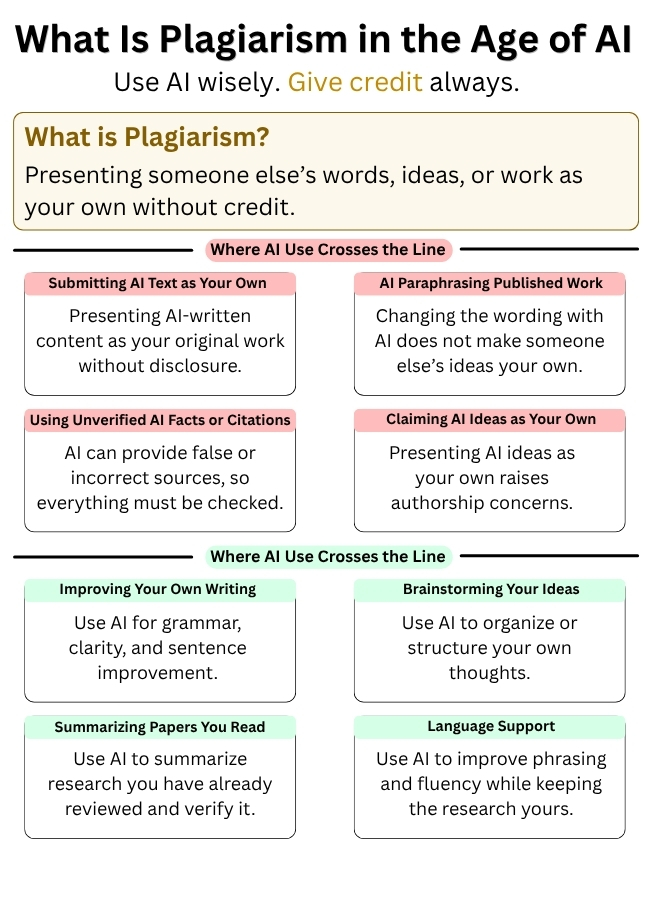
Plagiarism is presenting someone else’s words, ideas, or work as your own without proper credit.
That is it. It was never really about the source. It was always about ownership and honesty.
Universities and journals built entire policies around this idea long before generative AI existed. Copying a sentence from a journal article without citation was plagiarism in 1995. It is still plagiarism today.
So the first thing to understand is this: AI does not redefine plagiarism. It just gives people a new tool that can either help you stay on the right side of that definition, or push you straight past it.
Where AI Use Crosses Into Plagiarism
Here is where most of the real risk actually sits.
Submitting AI generated text as entirely your own work: If you ask a tool to write a section of your literature review and you submit it without disclosure, that is a problem. Not because AI wrote it, but because you presented someone else’s output, in this case a machine’s output, as your original thinking.
Using AI to paraphrase someone else’s published work: This one catches a lot of people off-guard. If you take a paragraph from a paper, feed it into an AI tool, and ask it to “say this differently,” you have not created something original. You have disguised someone else’s idea. The source still needs a citation, even after the wording changes.
Letting AI generate citations or facts you never verified: AI tools sometimes produce citations that look real but do not exist, or attribute findings to the wrong paper. Submitting this without checking is not just sloppy, it can count as fabrication on top of plagiarism.
Treating AI generated ideas as your own contribution: If an AI tool suggests a novel argument or framework and you present it as your original academic contribution without acknowledgment, that raises the same authorship concerns as taking credit for a colleague’s idea.
Where AI Use Is Generally Fine
Now the part that actually reassures most researchers I talk to.
Using AI to improve your own writing: Grammar checks, sentence restructuring, clarity edits. If the ideas and the underlying argument are yours, and you are simply using AI the way you would use a human editor, most institutions consider this acceptable. Many now expect it to be disclosed rather than banned outright.
Using AI to brainstorm or organize your own thoughts: Asking a tool to help you outline a chapter you already know the content of is closer to using a thinking tool than outsourcing your work.
Using AI to summarize papers you have already read: As long as you verify the summary against the original and it is not replacing your own reading and analysis, this is generally treated as a research productivity tool rather than misconduct.
Using AI for language support: For non native English speakers in particular, using AI to improve phrasing and fluency is widely accepted, provided the underlying research and argument remain your own.
The pattern across all of this is simple. AI assistance is generally fine. AI substitution is where the trouble starts.
What the Major Publishing Bodies Actually Say
This part is worth knowing because it is not just opinion. It is policy, and it is fairly consistent across the board.
The Committee on Publication Ethics, known as COPE, along with the International Committee of Medical Journal Editors and most major publishers including Elsevier, Springer Nature, Wiley, and PLOS, all converge on the same core rule.
AI tools cannot be listed as an author on a paper.
The reasoning is straightforward. Authorship comes with accountability. An author has to be able to stand behind the accuracy and integrity of the work, and a piece of software cannot do that. AI tools also cannot hold copyright, declare conflicts of interest, or give consent, all of which are baked into what authorship means.
What these bodies do require instead is disclosure. If you used an AI tool in a meaningful way while writing your manuscript, you are generally expected to state how you used it, typically in the methods or acknowledgements section. Hiding that use is where things shift from a grey area into a real integrity issue.
So the safest approach is not to avoid AI. It is to be transparent about it.
Can You Trust AI Detectors?
This is the part I think more researchers need to hear, because a lot of anxiety is being built on shaky ground.
AI detection tools like Turnitin are widely used, and Turnitin itself has claimed accuracy above 98 percent with a false positive rate under 1 percent on flagged documents.
Independent testing tells a more complicated story. Several studies, including research referencing Stanford’s work on detector bias, have found real world false positive rates ranging from roughly 3 to 15 percent on genuinely human written text. Nonnative English speakers are flagged at noticeably higher rates than native speakers, which is a serious fairness concern given how much academic writing happens in a second language.
This does not mean detectors are useless. It means their output should be treated as one signal, not a verdict. A high AI score is a reason to ask questions, not automatic proof of misconduct. Several universities, including Vanderbilt, have already scaled back or disabled AI detection specifically because of how often it produces false accusations at scale.
If you are ever flagged, keep your drafts. Version history in Google Docs or track changes in Word is often the strongest evidence you have that the work is genuinely yours.
A Simple Test You Can Use
When you are not sure whether something crosses the line, ask yourself one question.
If I removed the AI tool entirely, would this still represent my own thinking, my own words, and my own verified sources?
If yes, you are almost certainly fine, especially with disclosure.
Info, that is your signal to slow down and rework it yourself.
Final Thoughts
AI has not created a new definition of plagiarism. It has just made the old definition more important to actually understand.
To summarize where the line sits:
- Submitting AI generated text as your own original work is plagiarism.
- Using AI to disguise someone else’s published ideas through paraphrasing is still plagiarism.
- Unverified AI generated citations or facts are a serious risk.
- Using AI to edit, organize, or polish your own original work is generally acceptable, especially with disclosure.
- AI tools cannot be listed as authors, and transparency about their use is now expected by most major journals.
- AI detectors are useful but flawed, and should never be treated as the final word.
The researchers who will navigate this well are not the ones avoiding AI altogether.
They are the ones who understand exactly where their own thinking ends and the tool’s contribution begins, and who are honest about that line.
That is the real skill this new era is asking of us.