Writing a research paper can feel overwhelming, especially if you don’t have a clear structure in mind. Many researchers struggle not because of a lack of ideas, but because they don’t know how to organize those ideas effectively. A well-defined research paper outline acts like a roadmap, it guides your writing, ensures logical flow, and improves the overall quality of your work.

AI Tools to Make Your Research Easier
 Otio: An all-in-one workplace for researchers to 10x
your research productivity.
 Moara: The best AI-driven reference manager for
researchers. It’s simple magic
 Gatsbi: A tool for quick literature reviews, all with
credible citations
 SciSpace: Convert your papers into posters in
seconds
In this blog, we will break down the ideal research paper outline based on a proven academic structure: Abstract, Introduction, Literature Review, Methodology, Results, Discussion, and Conclusion. If you follow this structure, you will not only write faster but also produce a paper that is clear, impactful, and ready for publication.
Introduction: Why a Research Paper Outline Matters
Before diving into writing, it is essential to understand the purpose of a research paper outline. Think of it as the backbone of your study. Without it, your paper may lack direction, coherence, and clarity.
A strong outline helps you:
- Organize your ideas logically
- Maintain a clear argument throughout
- Avoid repetition and confusion
- Save time during writing and editing
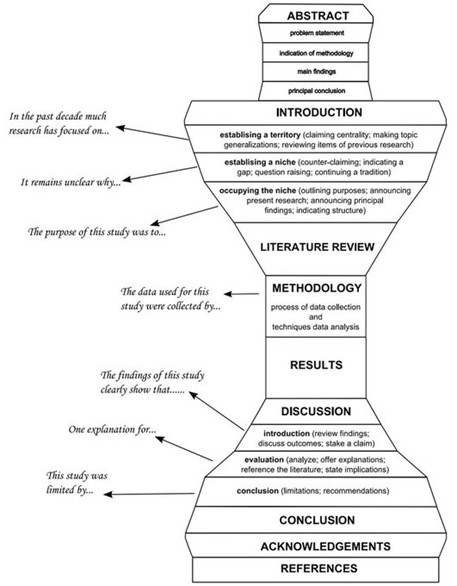
The structure shown in the image follows a funnel-like approach. You start broad, narrow down to your specific research problem, and then expand again when discussing results and implications. This logical progression is what makes academic papers easy to read and understand.
Methods: Structuring Each Section of Your Research Paper
Let’s break down each part of the research paper outline and understand what should be included.
Abstract: Your Paper in One Paragraph
The abstract is a concise summary of your entire study. It should include:
- The problem statement
- The methodology used
- Key findings
- The main conclusion
This is often the first (and sometimes only) part readers look at, so it must clearly communicate the value of your research.
Introduction: Establishing and Occupying the Research Niche
The introduction follows a three-step strategy:
- Establishing a Territory
Start by discussing the broader research area. Highlight general trends and summarize key previous studies. - Establishing a Niche
Identify gaps in existing research. What is missing? What remains unclear? This is where you position your research question. - Occupying the Niche
Clearly state your research objectives, purpose, and what your study aims to achieve.
A strong introduction answers the question: Why does this research matter?
Literature Review: Building the Foundation
The literature review dives deeper into existing studies. It should:
- Critically analyze previous research
- Identify patterns, agreements, and contradictions
- Highlight gaps that justify your study
Avoid simply summarizing papers. Instead, connect them and show how they lead to your research problem.
Methodology: Explaining Your Approach
This section describes how you conducted your research. It includes:
- Data collection methods
- Tools and techniques used
- Research design
- Analysis procedures
Clarity is key here. Another researcher should be able to replicate your study based on this section.
Results: Presenting Your Findings
In the results section, you present what you discovered:
- Use tables, graphs, and figures where necessary
- Keep it objective—no interpretation yet
- Highlight key patterns and trends
This section answers: What did you find?
Results: What a Well-Structured Paper Achieves
When you follow a proper research paper outline, the results are not just about your findings—they also reflect the quality of your writing. A well-structured paper leads to:
- Clear communication of ideas
- Stronger arguments and logical flow
- Better readability for reviewers and readers
- Higher chances of publication
Your results section becomes more impactful when it is supported by a strong introduction and methodology. Everything connects, making your research more convincing.
Discussion: Interpreting and Evaluating Your Findings
The discussion section is where your research truly comes to life. This is your opportunity to explain what your results mean.
You should:
- Interpret the findings
What do your results indicate? How do they answer your research question? - Compare with existing literature
Do your findings agree or contradict previous studies? - Provide explanations
Why did you get these results? What factors influenced them? - Discuss implications
What do these findings mean for theory, practice, or future research?
This section transforms raw data into meaningful insights.
Addressing Limitations and Recommendations
No study is perfect. A good discussion also acknowledges:
- Limitations of your research
- Possible biases or constraints
- Suggestions for future research
This shows critical thinking and strengthens the credibility of your work.
Conclusion: Bringing Everything Together
The conclusion is the final piece of your research paper outline. It should:
- Summarize the key findings
- Reinforce the importance of your study
- Provide final insights or recommendations
Avoid introducing new information here. Instead, focus on wrapping up your research in a clear and impactful way.
Additional Sections: Acknowledgements and References
Finally, don’t forget these important components:
- Acknowledgements
Recognize individuals or organizations that supported your research. - References
List all sources cited in your paper using the required academic style (APA, IEEE, Harvard, etc.).
Proper referencing not only avoids plagiarism but also strengthens the credibility of your work.
Conclusion: Mastering the Research Paper Outline
A well-structured research paper outline is the difference between a confusing paper and a compelling one. By following the structure outlined above—Abstract, Introduction, Literature Review, Methodology, Results, Discussion, and Conclusion—you can ensure your research is clear, logical, and impactful.
Remember, writing a research paper is not just about presenting data. It is about telling a story—your research story—in a way that others can understand, evaluate, and build upon.
If you master this structure, you will not only improve your academic writing but also significantly increase your chances of publishing in top journals.