Choosing the right citation style is one of the most common challenges students and researchers face. It may seem like a small detail, but using the correct referencing style is essential for academic credibility, clarity, and professionalism. The reality is simple: different disciplines follow different conventions, and understanding these conventions can significantly improve the quality of your research work.

AI Tools to Make Your Research Easier
 Otio: An all-in-one workplace for researchers to 10x productivity
 Cited Evidence: Convert thesis into a manuscript in minutes
 AnswerThis: Conduct literature reviews using AI in minutes
 WisPaper: Most accurate AI tool for searching research papers
In this guide, we’ll break down the most popular citation styles, who uses them, and how you can decide which one is right for your work.
Why Citation Styles Matter
Before diving into specific styles, it’s important to understand why citation styles exist in the first place.
Citation styles are not just formatting rules—they are systems designed to organize knowledge. They help readers trace your sources, verify your claims, and explore further research. A well-cited paper shows academic integrity and demonstrates that your arguments are built on credible foundations.
Different fields prioritize different types of information. For example, in scientific research, recent findings are crucial, while in humanities, the author’s identity and original text often matter more. This is why citation styles vary across disciplines.
APA Style (Social Sciences)
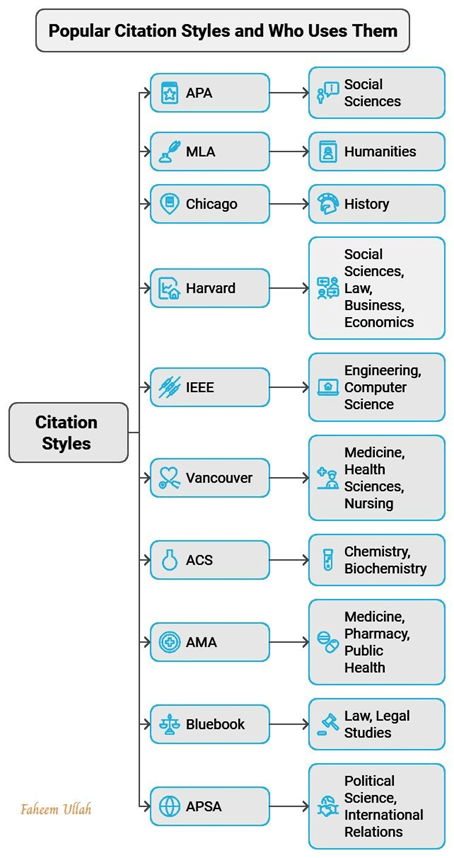
APA (American Psychological Association) is one of the most widely used citation styles, especially in psychology, education, and social sciences.
APA focuses on the author-date format, meaning citations include the author’s name and publication year (e.g., Smith, 2020). This makes it easy for readers to quickly identify how recent a source is.
This style is ideal if your research depends heavily on current studies, trends, or data analysis. It emphasizes clarity, conciseness, and structured formatting.
Best for: Psychology, Education, Sociology, Business (sometimes)

MLA Style (Humanities)
MLA (Modern Language Association) is commonly used in literature, languages, and cultural studies.
Unlike APA, MLA focuses more on the author and page number rather than the publication year. This is because humanities research often involves analyzing texts rather than tracking recent findings.
MLA allows for more flexibility in writing style and is less rigid compared to APA.
Best for: Literature, Languages, Cultural Studies
Chicago style is unique because it offers two systems:
- Notes and Bibliography (commonly used in humanities)
- Author-Date (similar to APA)
In history and related fields, the notes and bibliography system is preferred. It uses footnotes or endnotes, allowing for detailed explanations and additional context.
This makes Chicago style particularly useful when your work requires deep analysis, commentary, and referencing historical documents.
Best for: History, Philosophy, Arts
Harvard Style (Multi-Disciplinary Use)
Harvard referencing is widely used across many disciplines, including business, law, and economics.
It is similar to APA in that it follows an author-date format, but it is slightly more flexible and varies depending on institutions.
Harvard is often preferred because it is straightforward and easy to learn, making it a popular choice for universities worldwide.
Best for: Business, Law, Economics, Social Sciences
IEEE Style (Engineering and Computer Science)
IEEE (Institute of Electrical and Electronics Engineers) is the standard for technical fields.
This style uses numbered citations (e.g., [1], [2], [3]) instead of author names. References are listed in the order they appear in the text.
IEEE is efficient and compact, which is ideal for technical writing where clarity and brevity are essential.
Best for: Engineering, Computer Science, IT

Vancouver Style (Medical and Health Sciences)
Vancouver style is widely used in medicine and health-related research.
Like IEEE, it uses numbered citations, making it easy to follow in papers with many references.
This style is designed for fast reading and quick referencing, which is crucial in clinical and scientific environments.
Best for: Medicine, Nursing, Health Sciences
ACS Style (Chemistry)
ACS (American Chemical Society) is specifically designed for chemistry and biochemistry.
It supports multiple citation formats, including numbered and author-date systems, depending on the journal or institution.
ACS ensures that complex chemical research is presented clearly and consistently.
Best for: Chemistry, Biochemistry
AMA Style (Medical Research)
AMA (American Medical Association) is another key style in medical and healthcare research.
It uses superscript numbers for citations and is known for its precise and structured format.
AMA is particularly useful in clinical research where accuracy and consistency are critical.
Best for: Medicine, Pharmacy, Public Health
Bluebook (Legal Studies)
The Bluebook is the standard citation style for legal writing.
It is highly detailed and includes specific rules for citing cases, statutes, and legal documents.
While it can be complex, it is essential for maintaining precision in legal arguments.
Best for: Law, Legal Studies
APSA Style (Political Science)
APSA (American Political Science Association) is commonly used in political science and international relations.
It is similar to APA but tailored for political research, focusing on clarity and proper attribution of sources.
Best for: Political Science, International Relations
How to Choose the Right Citation Style
With so many options available, choosing the right citation style can feel overwhelming. Here are a few simple steps to guide your decision:
1. Follow Your Institution or Journal Guidelines
This is the most important rule. Universities, professors, and journals usually specify the required citation style. Always follow their instructions first.
2. Consider Your Discipline
Different fields have established standards. For example:
- Social sciences → APA or Harvard
- Humanities → MLA or Chicago
- Engineering → IEEE
- Medicine → Vancouver or AMA
3. Understand the Purpose of Your Work
Ask yourself:
- Is your research based on recent studies? → APA/Harvard
- Is it text-based analysis? → MLA/Chicago
- Is it technical or data-heavy? → IEEE
4. Look at Published Papers
Check papers in your field and see which style they use. This gives you a practical understanding of expectations.
Common Mistakes to Avoid
Even when you choose the right style, mistakes can reduce the quality of your work. Here are some common ones:
- Mixing citation styles in one paper
- Incorrect formatting of references
- Missing citations for borrowed ideas
- Inconsistent use of punctuation and italics
Using reference management tools can help avoid these errors and save time.
Final Thoughts
Choosing the right citation style is not just about formatting—it’s about aligning your work with the standards of your academic community. Each style reflects the priorities of a specific discipline, whether it’s clarity, recency, depth, or precision.
The key is simple: know your field, follow the guidelines, and stay consistent.
Once you understand the logic behind citation styles, they stop feeling like rules—and start becoming tools that strengthen your research.