

Every strong research study begins with a clear direction. That direction often comes from a well-defined research hypothesis.
A hypothesis is not just a guess. It is a testable statement that predicts the relationship between variables. It gives your research focus, guides your methodology, and helps you interpret results clearly.
Many students and early researchers struggle with choosing the right type of hypothesis. Using the wrong type can lead to weak analysis, unclear conclusions, and poor research outcomes.
This guide explains the main types of research hypotheses in a simple and practical way so you can apply them directly in your research.
AI tools of the week:
Raaye: An AI driven platform for creating and managing social media content

PACR: An AI-powered research ecosystem for researchers and academics

UPDF: An AI-powered PDF editor that streamlines working with PDFs on the go

Sciclaw: An AI-powered research assistant for literature review, diagrams, and slides

What is a Research Hypothesis
A research hypothesis is a clear, specific, and testable prediction about the expected outcome of a study.
It typically includes:
- A relationship between variables
- A measurable outcome
- A statement that can be tested with data
Why Understanding Types of Hypotheses Matters
Understanding hypothesis types helps you:
- Design better research studies
- Choose appropriate statistical methods
- Improve clarity in your research writing
- Avoid common methodological mistakes
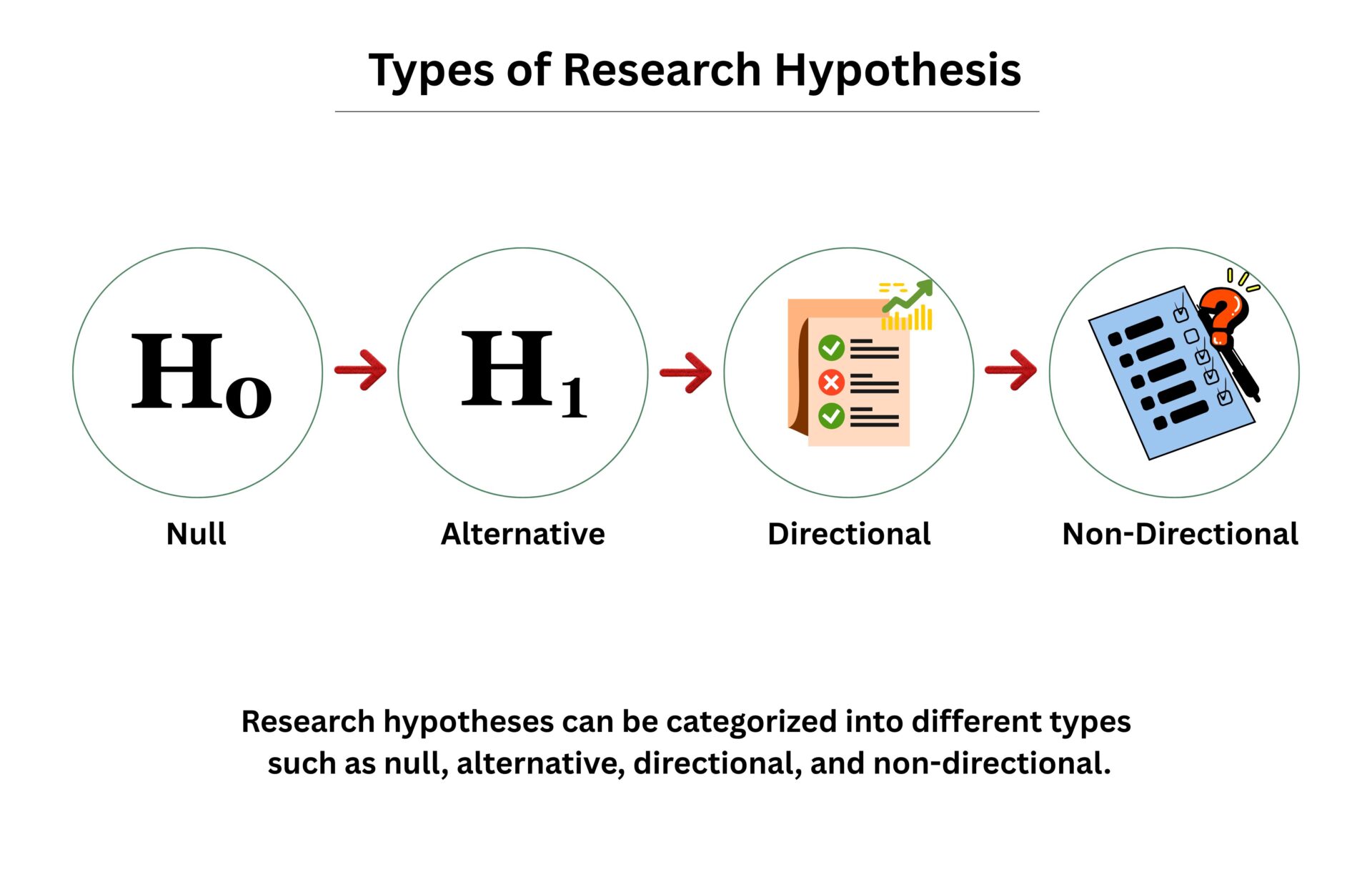
1. Null Hypothesis
The null hypothesis states that there is no relationship between variables.
Example: There is no difference in academic performance between students who study in the morning and those who study at night.
Key points:
- It is the default assumption in research
- Researchers try to reject it using data
- It is essential for statistical testing
2. Alternative Hypothesis
The alternative hypothesis states that there is a relationship or effect.
Example: Students who study in the morning perform better than those who study at night.
Key points:
- Opposite of the null hypothesis
- Represents what the researcher aims to support
- Accepted when null hypothesis is rejected
3. Directional Hypothesis
A directional hypothesis specifies the direction of the relationship.
Example: Increased screen time leads to lower academic performance.
Key points:
- Shows whether the relationship is positive or negative
- Used when prior research supports a specific outcome
- Allows more focused analysis
4. Non-Directional Hypothesis
A non-directional hypothesis states that a relationship exists but does not specify direction.
Example: There is a relationship between screen time and academic performance.
Key points:
- Does not indicate increase or decrease
- Used when outcomes are uncertain
- Suitable for exploratory research
5. Simple Hypothesis
A simple hypothesis involves one independent variable and one dependent variable
Example: Sleep duration affects exam performance.
Key points:
- Easy to test and interpret
- Common in basic research studies
- Clear and focused

6. Complex Hypothesis
A complex hypothesis involves two or more independent variables and two or more dependent variables
Example: Sleep duration and study habits affect exam performance and stress levels.
Key points:
- Reflects real-world complexity
- Used in advanced research
- Requires more detailed analysis
7. Associative Hypothesis
An associative hypothesis describes a relationship between variables without claiming causation.
Example: Students with higher attendance tend to have better grades.
Key points:
- Shows correlation, not cause
- Common in observational studies
- Important for identifying patterns
8. Causal Hypothesis
A causal hypothesis states that one variable causes a change in another.
Example: Increased study time improves academic performance.
Key points:
- Establishes cause-and-effect relationship
- Requires controlled research design
- Often tested through experiments
9. Statistical Hypothesis
A statistical hypothesis is expressed in mathematical form and tested using statistical methods.
Example: The mean score of group one is equal to the mean score of group two.
Key points:
- Used in quantitative research
- Supports hypothesis testing using data
- Essential for significance testing
Common Mistakes Researchers Make
Avoid these common mistakes:
- Writing vague or unclear hypotheses
- Including multiple ideas in one statement
- Making hypotheses that cannot be tested
- Confusing correlation with causation
- Choosing the wrong hypothesis type for the study
How to Choose the Right Hypothesis Type
To select the right hypothesis, consider:
- Do you expect a specific direction? → Use a directional hypothesis
- Are you testing cause or relationship? → Causal or associative
- How many variables are involved? → Simple or complex
- Are you doing statistical testing? → Include null and alternative hypotheses
Final Thoughts
A research hypothesis is the foundation of any strong study. It shapes your research design, guides your analysis, and determines how your results are interpreted.
Understanding the different types of hypotheses allows you to choose the most appropriate one for your research. This leads to clearer findings, stronger arguments, and better overall research quality.
Mastering this skill is essential for anyone who wants to produce high-quality academic work and succeed in research.
Dear Dr. Faheem,
Thank you so much I've now clear understanding how to test hypothesis.