You have spent three, four, or perhaps five years working on your PhD.
You have read hundreds of research papers, collected data, conducted experiments, written thousands of words, revised countless chapters, and finally submitted your thesis.
AI tools of the week:
AnswerThis : An AI-powered tool for systematic literature reviews.

Gatsbi : An AI-powered tool for writing research papers.

Ponder : A tool for identifying research gaps and research questions.

Thesify : A tool for reviewing papers and thesis before submission.

Then comes one uncomfortable question:
What will the examiners actually look for in my PhD thesis?
Many PhD students imagine that examiners are searching for mistakes on every page. In reality, a PhD thesis is not expected to be perfect. Examiners know that research has limitations, experiments do not always produce perfect results, and every study leaves unanswered questions.
What matters is whether your thesis demonstrates that you can conduct independent, rigorous, original research and make a meaningful contribution to your field.
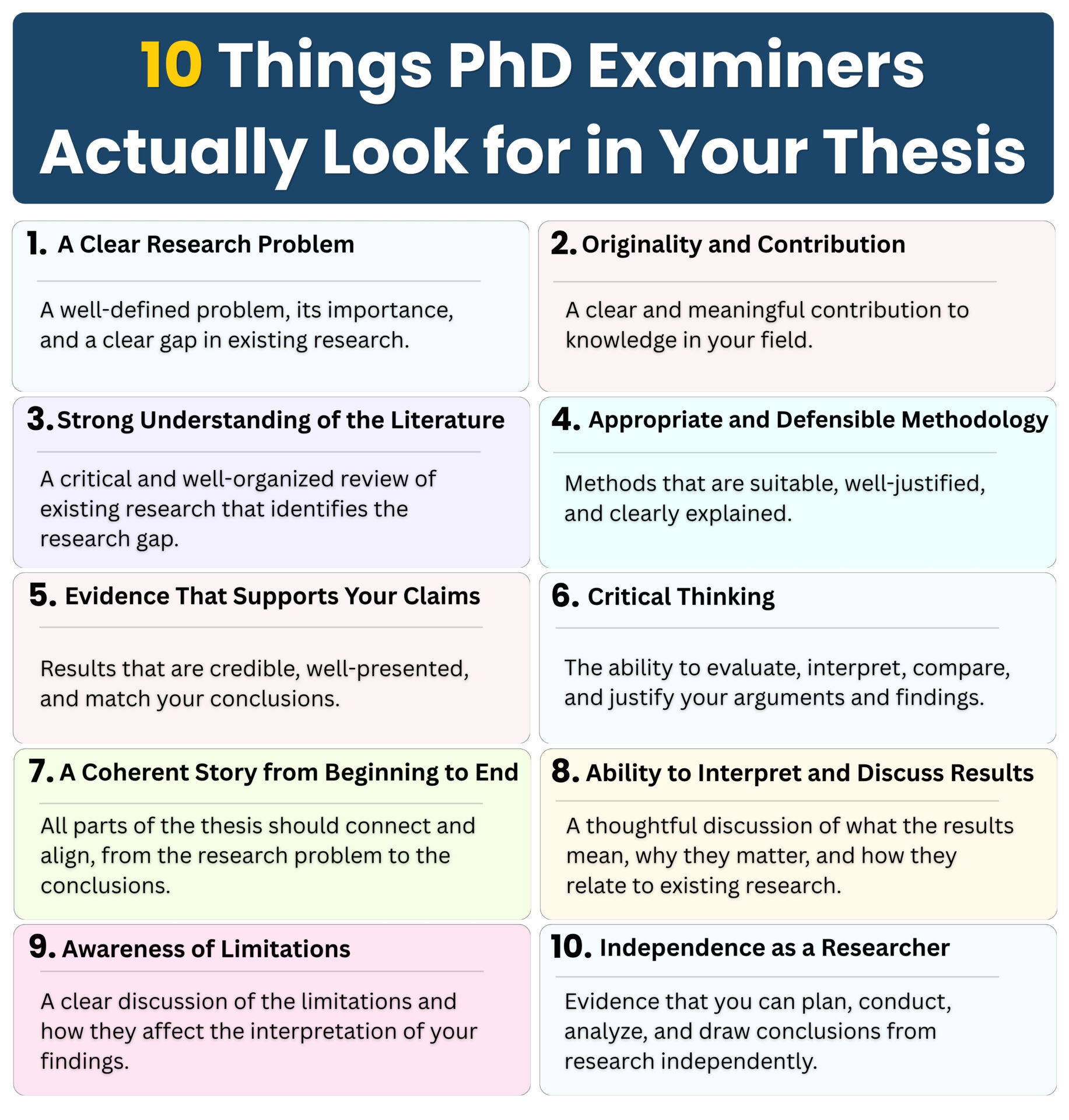
Here are some of the most important things PhD examiners typically look for.
1. A Clear Research Problem
One of the first things an examiner wants to understand is:
What problem is this thesis trying to solve?
A strong PhD thesis should clearly explain the research problem and why it matters.
By the end of the introduction, an examiner should understand:
- What problem you are investigating
- Why the problem is important
- What is currently known
- What is missing from existing research
- How your research addresses that gap
If the examiner finishes the introduction and still cannot clearly explain why the research was needed, that is a problem.
Your thesis should therefore tell a clear story:
Here is the problem → Here is what we already know → Here is what we do not know → Here is what my research does about it.
2. Originality and Contribution to Knowledge
A PhD is not simply a very long research project.
It must contribute something new.
This does not mean you have to completely transform your field or invent something revolutionary. Your contribution can be relatively focused.
For example, your research might:
- Develop a new method or framework
- Apply an existing method in a new context
- Produce new empirical evidence
- Challenge an existing assumption
- Develop or test a new theory
- Create a new dataset, model, or system
- Provide a new interpretation of an existing problem
The important thing is that the examiner can clearly identify:
“What do we know now that we did not know before this PhD?”
Do not make the examiner search through 200 pages to find your contribution. State it clearly.
3. Strong Understanding of the Literature
Examiners also want to see whether you understand the research field in which your thesis sits.
This is why the literature review is so important.
A weak literature review simply describes previous studies:
Researcher A found this. Researcher B studied that. Researcher C proposed this model.
A strong literature review goes further.
It compares studies, identifies disagreements, evaluates methodologies, highlights limitations, finds patterns, and eventually establishes the research gap.
Your literature review should demonstrate that you can think critically about existing research rather than simply summarize it.
An examiner should finish your literature review thinking:
“This researcher understands the field and knows exactly where their research fits.”
4. Appropriate and Defensible Methodology
Your methodology does not necessarily need to be complicated.
It needs to be appropriate.
Examiners will ask whether the methods you selected actually allow you to answer your research questions.
They may consider questions such as:
- Why did you choose this research method?
- Why was this dataset or sample appropriate?
- How were participants selected?
- Why did you use these particular experiments?
- Why did you choose this statistical technique?
- What alternatives did you consider?
- What are the limitations of your approach?
Simply saying, “Previous researchers used this method” is usually not a strong justification.
You should demonstrate that methodological decisions were made deliberately and that you understand both the strengths and weaknesses of those decisions.
5. Evidence That Supports Your Claims
A PhD thesis should not make claims that the research cannot support.
Imagine your experiment shows that Method A performed better than Method B on one dataset.
You might reasonably conclude:
“Method A outperformed Method B on the dataset used in this study.”
But claiming:
“Method A is the best method for all applications.”
would require much stronger evidence.
Examiners pay attention to this difference.
Your conclusions should follow logically from your results. Avoid exaggerating what your research proves.
Good researchers know not only what their results show, but also what their results do not show.
6. Critical Thinking
This is one of the most important qualities examiners look for.
A PhD student should not simply report information. You should be able to evaluate, question, compare, interpret, and justify.
For example, instead of writing:
“Model A achieved 92% accuracy.”
ask:
Why did it achieve 92%?
How does this compare with previous studies?
Under what conditions might its performance decrease?
What are the practical implications?
What limitations affect the result?
This deeper level of thinking distinguishes doctoral research from a simple technical report.
7. A Coherent Story from Beginning to End
Your thesis may contain several studies, experiments, chapters, or research questions, but they should all feel like parts of one research story.
An examiner should be able to follow the connection between:
Research problem → Literature gap → Research questions → Methodology → Results → Discussion → Contribution
Problems occur when these elements do not align.
For example, your introduction may promise to answer five research questions, but your results only address four.
Or your literature review may identify one research gap while your methodology investigates something slightly different.
Before submitting your thesis, check that the story you introduce at the beginning is the same story you complete at the end.
8. Ability to Interpret and Discuss Results
Getting results is only part of research.
You must explain what those results mean.
This is why the discussion chapter is so important.
A strong discussion does not simply repeat the results. Instead, it explains:
- Why the findings matter
- Why certain results occurred
- Whether the findings support your expectations
- How they compare with previous studies
- What unexpected findings mean
- What the theoretical or practical implications are
Suppose your proposed model performs worse than expected.
That does not automatically make the PhD unsuccessful.
An unexpected or negative result can still make a valuable contribution if you can explain it, analyze it critically, and show what researchers can learn from it.
9. Awareness of Limitations
Some PhD students worry that discussing limitations will make their thesis appear weak.
Usually, the opposite is true.
Every research project has limitations.
Your sample may be small. Your dataset may come from one country. Your experiments may test only certain conditions. Your model may make assumptions that do not always hold.
Examiners are likely to notice these limitations anyway.
Acknowledging them shows that you understand the boundaries of your research.
More importantly, explain how those limitations affect the interpretation or generalizability of your findings.
That demonstrates research maturity.
10. Independence as a Researcher
Ultimately, a PhD is training you to become an independent researcher.
Your thesis should therefore demonstrate that you can:
- Identify an important research problem
- Understand the relevant literature
- Develop appropriate research questions
- Select and justify methods
- Conduct rigorous research
- Analyze evidence
- Critically interpret findings
- Recognize limitations
- Draw defensible conclusions
- Identify opportunities for future research
The examiner is not only evaluating the document.
In many ways, they are evaluating the researcher behind the document.
What Examiners Are NOT Expecting
Perhaps the most reassuring thing to remember is that examiners are generally not expecting a perfect thesis.
A PhD thesis does not need to solve every problem in your field.
It does not need perfect results.
It does not need to contain a revolutionary discovery.
It does not need to be free from every possible limitation.
What it does need is a clear and defensible contribution to knowledge, supported by rigorous research and critical thinking.
Final Thoughts
When preparing your PhD thesis for submission, do not focus only on grammar, formatting, page numbers, and word count.
Step back and ask yourself:
Is my research problem clear?
Is the research gap convincing?
Can I explain my original contribution in a few sentences?
Do my methods answer my research questions?
Do my conclusions match my evidence?
Have I critically discussed my findings and limitations?
If you can confidently answer these questions, you are already thinking about your thesis in the way an examiner is likely to think about it.
Your PhD thesis does not have to prove that you know everything.
It needs to prove something more important:
You know how to do research.