

One of the biggest challenges in academic research is finding a strong research gap. Many PhD students and researchers spend months reading papers but still struggle to identify what is actually missing in the literature.
The reason is simple: research gaps are rarely obvious.
Strong research gaps are discovered through systematic analysis of the literature, not by randomly reading papers one after another. Researchers who know how to identify meaningful gaps develop stronger research proposals, publish higher-quality papers, and build more original theses.
In this blog, you will learn a practical 5-step method to identify research gaps effectively and develop stronger research questions.
AI tools of the week:
Thesify: Receive personalized guidance for your PhD

Gatsbi: A tool for quick literature reviews, all with credible citations

Cited Evidence: Help you to write a systematic literature review in 1 day

PatsNap Eureka: Identify trends in research.

What Is a Research Gap?
A research gap is an unresolved issue, limitation, contradiction, or unexplored area within existing literature.
In simple terms, it is something important that researchers still do not fully understand.
Research gaps can appear in different forms:
- Conflicting findings between studies
- Understudied populations or industries
- Weak methodologies
- Missing theoretical perspectives
- Unexplored contexts or environments
A strong research gap explains why your study is necessary.
Without a clear gap:
- Your research may appear repetitive
- Your proposal may seem weak
- Reviewers may question originality
This is why identifying a meaningful research gap is one of the most important stages of academic research.
Why Most Researchers Struggle to Find Research Gaps
Most researchers approach literature reviews incorrectly.
They read papers individually while searching for “missing topics.” However, research gaps rarely appear directly inside one paper.
Instead, strong gaps emerge when researchers compare multiple studies and analyze patterns across the literature.
A research gap is often hidden:
- Between conflicting findings
- Inside repeated limitations
- Across different contexts
- Within overlooked assumptions
This requires strategic reading rather than random reading.
The good news is that there is a systematic way to identify meaningful gaps.
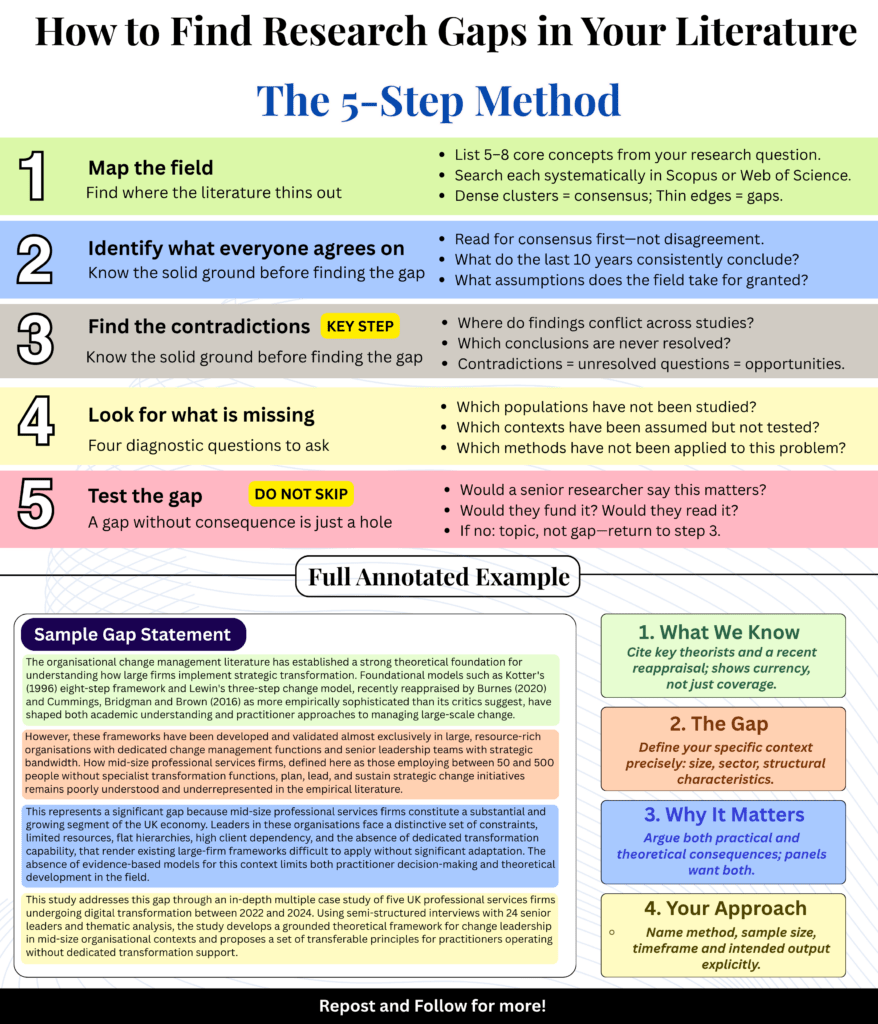
Step 1: Map the Research Field
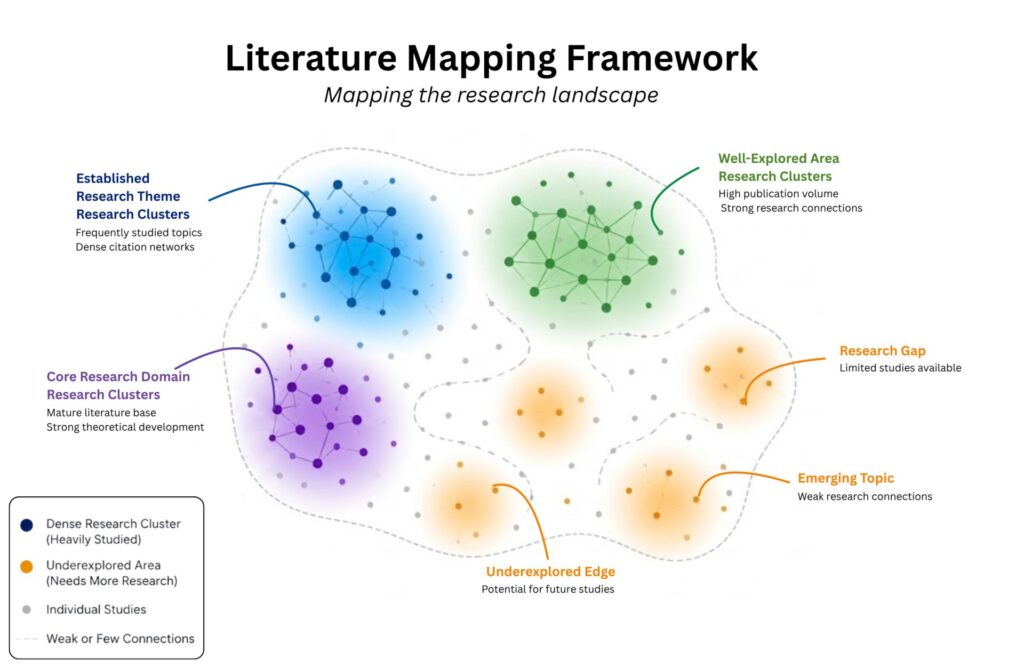
The first step is understanding the overall structure of your research area.
Before searching for gaps, identify:
- Core concepts
- Major variables
- Frequently studied topics
- Dominant theories
- Common methodologies
Search these systematically using academic databases such as:
- Scopus
- Web of Science
- Google Scholar
As you review the literature, patterns will begin to appear.
Some areas will contain:
- Large clusters of studies
- Strong agreement between researchers
- Extensive evidence
Other areas will appear thin or weakly explored.
These thin areas often indicate potential research gaps.
For example:
You may discover hundreds of studies on digital transformation in large organizations but very limited research on small businesses or emerging economies.
That may indicate a contextual gap.
Step 2: Identify What Everyone Agrees On
Before finding a research gap, you must first understand the established consensus in the field.
Ask yourself:
- What conclusions appear repeatedly?
- Which theories dominate the literature?
- What assumptions are widely accepted?
- Which findings are considered stable?
This helps you understand the “solid ground” of the literature before searching for weaknesses or unresolved questions.
Many beginner researchers make the mistake of identifying already-solved problems as research gaps.
For example:
If the literature consistently shows that remote work improves flexibility, your contribution should not simply repeat that finding.
Instead, you should investigate unresolved aspects such as:
- Long-term productivity effects
- Industry-specific differences
- Mental health consequences
- Leadership challenges in remote environments
The strongest research gaps emerge after understanding what the field already knows.
Step 3: Find the Contradictions
One of the most powerful ways to identify publishable research gaps is to look for contradictions in the literature.
Research contradictions often indicate unresolved scientific questions.
Look for:
- Conflicting results
- Opposing conclusions
- Inconsistent evidence
- Theoretical disagreements
For example:
One study may conclude that social media improves academic engagement, while another reports negative academic outcomes.
This contradiction creates a strong research opportunity.
Contradictions matter because they signal uncertainty.
And uncertainty creates research value.
Pay close attention to phrases such as:
- “Findings remain inconsistent”
- “Results are mixed”
- “Further investigation is needed”
- “Evidence remains limited”
These phrases often point directly toward potential research gaps.
Step 4: Look for What Is Missing
Sometimes the research gap is not contradiction. It is absence.
Ask the following diagnostic questions:
- Which populations have not been studied?
- Which industries or countries are missing?
- Which theories have not been applied?
- Which methodologies are underused?
- Which time periods lack evidence?
This step often reveals highly valuable research opportunities.
For example:
A large amount of research may exist on AI adoption in Western countries, but very limited evidence may exist for developing economies.
Similarly:
Most studies may rely heavily on surveys while very few use interviews, experiments, or longitudinal analysis.
These become methodological and contextual gaps.
One highly effective strategy is carefully reading the “limitations” and “future work” sections of papers.
Researchers often indirectly reveal opportunities for future studies there.
Step 5: Test Whether the Gap Really Matters
This is the most overlooked step in research gap identification.
Not every gap is meaningful.
A strong research gap should be:
- Important
- Relevant
- Researchable
- Valuable to the field
Ask yourself:
- Would researchers care about this issue?
- Does this gap advance knowledge?
- Would journals publish this topic?
- Does it have practical or theoretical significance?
A gap without significance is simply an empty space.
For example:
Studying an extremely narrow issue with little academic or practical relevance may technically fill a gap but still fail to attract attention from journals or reviewers.
The strongest research gaps combine:
- Feasibility
- Novelty
- Importance
How to Write a Strong Research Gap Statement
Once you identify the gap, you must explain it clearly.
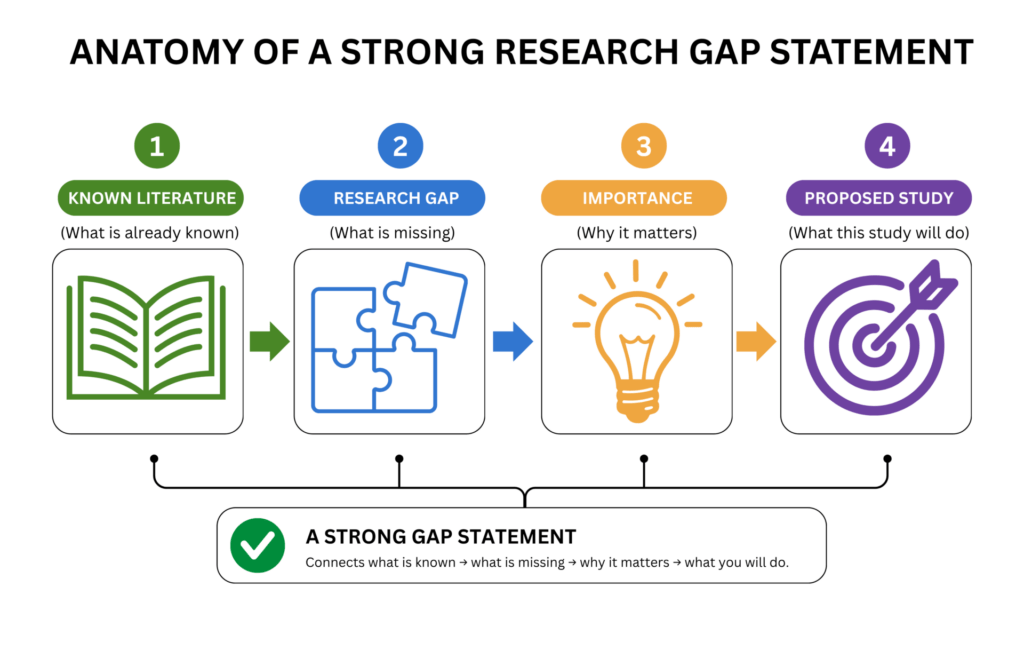
A strong research gap statement usually contains four parts:
1. What We Already Know
Summarize existing evidence briefly.
2. The Gap
Clearly explain what is missing or unresolved.
3. Why It Matters
Explain theoretical or practical importance.
4. Your Proposed Approach
Describe how your study addresses the gap.
A simple structure looks like this:
“Although previous studies have examined X, limited research has explored Y within the context of Z. This gap is important because ____. Therefore, this study investigates ____.”
This structure improves clarity and strengthens your proposal significantly.
Common Mistakes Researchers Make
Many researchers struggle because they:
- Confuse topics with gaps
- Choose gaps that are too broad
- Ignore contradictions in the literature
- Focus only on recent papers
- Select gaps without practical importance
- Read papers passively instead of analytically
Another major mistake is assuming that “no studies found” automatically means a strong gap.
Sometimes topics remain unstudied because they are not meaningful, feasible, or important.
Strong gaps solve meaningful problems.
Final Thoughts
Finding a research gap is not about discovering a random unstudied topic.
It is about systematically analyzing the literature to uncover:
- Contradictions
- Missing perspectives
- Weak evidence
- Underexplored contexts
- Unresolved scientific questions
The best researchers do not simply read papers.
They analyze patterns across papers.
Once you master this skill, writing research proposals, theses, and journal papers becomes significantly easier.
A strong research gap is the foundation of strong research.
It is intelligent collaboration between researchers and AI systems.
Dear Dr. Faheem,
Thank you so much for this week newsletter. I've been learning how to identify strong research gaps systematically from highly indexed sources. This enables me to formulate scholarly research questions and proceed to next steps of research process.