If you ask ten PhD students what a research thesis is, you will probably get ten slightly different answers. Some think every thesis follows the same structure, while others believe the type of thesis depends only on the degree they are pursuing. In reality, there are many different types of research theses, and understanding them can save you months of confusion before you even begin writing.
AI tools of the week:
Sourcely: An AI tool for automatically inserting citations in text

Yomu AI: A tool for smart research writing.

Gatsbi: An AI platform for writing papers and literature reviews

AnswerThis: An all-in-one platform for automating research tasks.

One of the most common mistakes I see among students is choosing a research topic before understanding the type of thesis they are expected to produce. A thesis is much more than a long document—it is a structured demonstration of your ability to conduct independent research and contribute new knowledge to your field.
In this guide, I will explain the major types of research theses, when each one is used, and the advantages and challenges of each approach. Whether you are starting a bachelor’s dissertation, a master’s thesis, or a PhD dissertation, this article will help you understand which type of research thesis best matches your research goals.
What Is a Research Thesis?
A research thesis is a formal academic document that presents original research conducted by a student. It explains the research problem, reviews previous studies, describes the methodology, presents findings, and discusses their significance.
The exact structure and expectations vary depending on the discipline, university, and degree level. However, every thesis aims to answer a research question through systematic investigation.
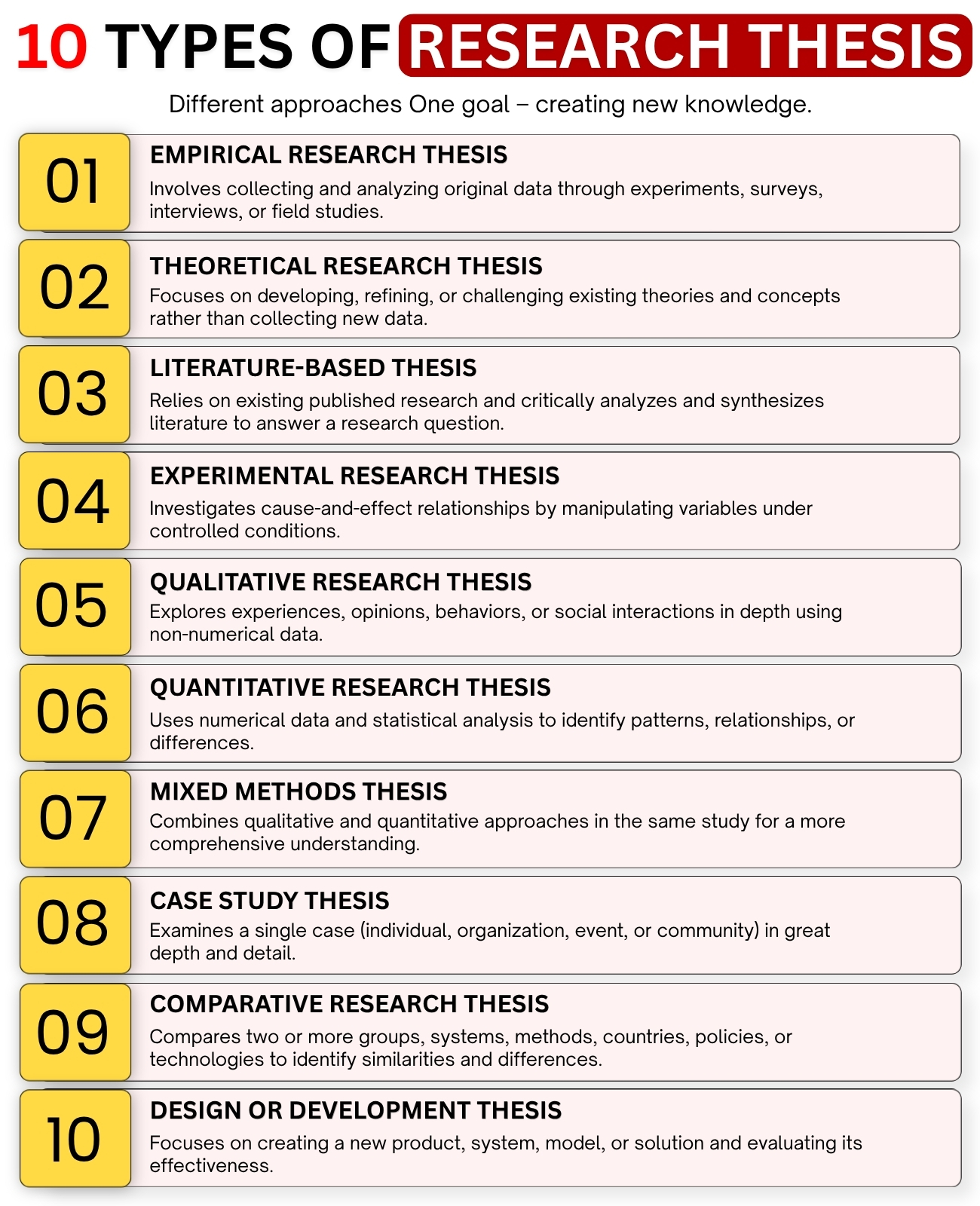
1. Empirical Research Thesis
An empirical thesis is the most common type of research thesis, especially in science, engineering, medicine, psychology, education, and social sciences.
In this type of thesis, researchers collect their own data through experiments, surveys, interviews, observations, laboratory work, or field studies. The conclusions are based on evidence gathered during the research rather than on existing literature alone.
Common methods include:
- Experiments
- Surveys
- Interviews
- Field observations
- Laboratory measurements
- Clinical studies
Best suited for:
- Natural sciences
- Engineering
- Medicine
- Psychology
- Education
- Business research
Advantages
- Produces original findings
- Strong scientific credibility
- Contributes new evidence
Challenges
- Time-consuming
- Requires data collection
- Often involves ethical approval
2. Theoretical Research Thesis
A theoretical thesis focuses on developing, refining, or challenging existing theories rather than collecting new data.
Instead of conducting experiments, researchers analyse existing theories, mathematical models, logical arguments, or conceptual frameworks to generate new insights.
This type is common in mathematics, philosophy, economics, computer science, and theoretical physics.
Examples
- Developing a new machine learning algorithm
- Proposing a new economic model
- Extending an existing theory
- Creating a conceptual framework
Advantages
- Encourages innovation
- Requires deep critical thinking
- Less dependent on data collection
Challenges
- Difficult to demonstrate originality
- Requires extensive theoretical knowledge
3. Literature-Based Thesis
A literature-based thesis relies primarily on published research rather than collecting original data.
The researcher critically analyses existing studies to answer a research question or identify patterns, trends, or research gaps.
Unlike a simple literature review, this type requires critical evaluation and synthesis of evidence.
Common forms include:
- Systematic literature reviews
- Scoping reviews
- Narrative reviews
- Meta-syntheses
- Umbrella reviews
Advantages
- Lower research cost
- Suitable when primary data are unavailable
- Excellent for identifying research gaps
Challenges
- Requires excellent analytical skills
- Needs comprehensive database searching
4. Experimental Research Thesis
An experimental thesis investigates cause-and-effect relationships by manipulating one or more variables under controlled conditions.
Researchers divide participants or samples into experimental and control groups and compare the outcomes.
This type is widely used in medicine, biology, chemistry, psychology, agriculture, and engineering.
Examples
- Testing a new drug
- Comparing two teaching methods
- Evaluating a new engineering material
- Measuring crop performance under different conditions
Advantages
- Strong evidence
- High internal validity
- Supports causal conclusions
Challenges
- Can be expensive
- Requires careful experimental design
- Ethical considerations may apply
5. Qualitative Research Thesis
A qualitative thesis explores people’s experiences, behaviours, opinions, beliefs, or social interactions.
Rather than focusing on numbers, qualitative research aims to understand why and how people think or behave in particular ways.
Researchers typically collect data using:
- Interviews
- Focus groups
- Observations
- Case studies
- Document analysis
Suitable fields
- Sociology
- Education
- Psychology
- Nursing
- Anthropology
- Public health
Advantages
- Rich, detailed insights
- Explores complex human experiences
- Flexible research design
Challenges
- Smaller sample sizes
- Time-intensive analysis
- Findings are less easily generalised
6. Quantitative Research Thesis
A quantitative thesis uses numerical data and statistical analysis to answer research questions.
Researchers often use large datasets and statistical software to identify relationships, trends, or significant differences.
Common techniques
- Surveys
- Statistical modelling
- Regression analysis
- Machine learning
- Data mining
Advantages
- Objective analysis
- Large sample sizes
- Results can often be generalised
Challenges
- Requires statistical knowledge
- May overlook contextual details
7. Mixed Methods Thesis
A mixed methods thesis combines qualitative and quantitative research within the same study.
For example, a researcher may first conduct interviews to explore a problem and then distribute a survey to measure how common those findings are.
This approach provides both numerical evidence and deeper explanations.
Advantages
- Comprehensive understanding
- Stronger evidence
- Balances strengths of both methods
Challenges
- Requires expertise in multiple methodologies
- More time-consuming
- More complex analysis
8. Case Study Thesis
A case study thesis investigates a single organisation, individual, event, project, or community in great depth.
Instead of analysing many cases, researchers focus on understanding one case comprehensively.
Examples
- One hospital
- One university
- One company
- One patient
- One city
Advantages
- Detailed understanding
- Practical relevance
- Excellent for real-world problems
Challenges
- Limited generalisability
- Requires extensive data collection
9. Comparative Research Thesis
A comparative thesis compares two or more groups, systems, methods, countries, technologies, or policies.
The goal is to identify similarities, differences, strengths, and weaknesses.
Examples
- Comparing healthcare systems
- Comparing machine learning algorithms
- Comparing educational approaches
- Comparing environmental policies
Advantages
- Supports evidence-based decision-making
- Highlights best practices
Challenges
- Requires comparable datasets
- Complex interpretation
10. Design or Development Thesis
Common in engineering, computer science, architecture, and information technology, this thesis focuses on creating something new.
Rather than simply analysing existing knowledge, researchers develop a practical solution to a real-world problem.
Examples
- Software applications
- AI models
- Mobile apps
- Medical devices
- Engineering prototypes
- Decision support systems
The developed solution is usually evaluated using experiments or performance testing.
Advantages
- High practical impact
- Encourages innovation
- Strong industry relevance
Challenges
- Requires technical expertise
- Development and testing can be lengthy
Which Type of Research Thesis Should You Choose?
The best type of thesis depends on several factors:
- Your research question
- Degree requirements
- Available resources
- Time constraints
- Supervisor’s expertise
- Access to data
- Personal interests
For example, if you enjoy working with people, a qualitative or mixed methods thesis may be ideal. If you enjoy statistics and data analysis, a quantitative thesis may be a better fit. If you prefer building solutions, a design or development thesis could be the perfect choice.
Always discuss your options with your supervisor before finalising your research proposal.
Common Mistakes Students Make
Many students struggle with their thesis because they choose the wrong research approach. Some collect data when a literature-based thesis would answer the research question more effectively. Others attempt complex mixed methods research without sufficient time or expertise.
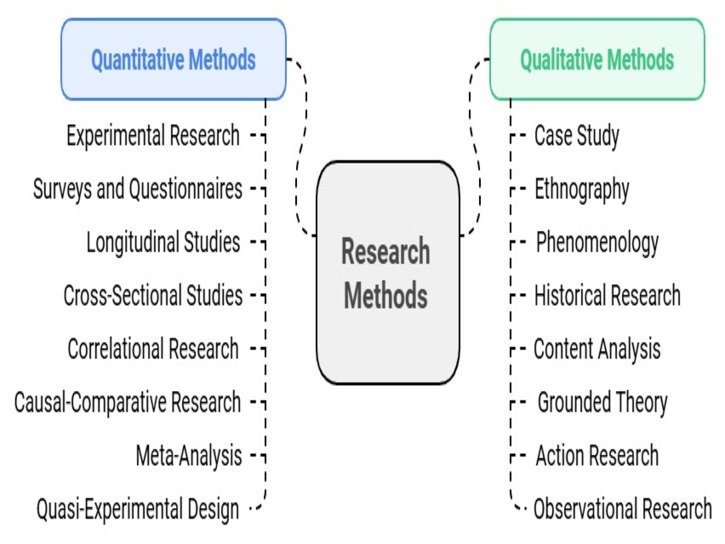
Another frequent mistake is confusing research methodology with thesis type. A thesis may be empirical while using qualitative methods, or it may be empirical while using quantitative methods. Understanding these distinctions will help you design a stronger research project from the beginning.
Final Thoughts
Choosing the right type of research thesis is one of the most important decisions you will make during your academic journey. Each thesis type has its own purpose, strengths, and challenges, and there is no single “best” option. The right choice depends on your research objectives, your discipline, and the contribution you want to make.
Before writing your proposal, spend time understanding the expectations of your university and discussing possible approaches with your supervisor. A well-chosen thesis type will make your research more focused, easier to manage, and far more impactful.
Remember, a successful thesis is not measured by its length but by the quality of its research, the clarity of its methodology, and the value of the knowledge it contributes to your field. By selecting the appropriate type of research thesis from the outset, you lay a strong foundation for producing meaningful, credible, and publishable research.