

Writing a PhD thesis is one of the most important and challenging parts of a doctoral journey. After spending several years conducting experiments, reviewing literature, collecting data, and publishing papers, every PhD student eventually faces the same question: How do I turn all of this work into a well-structured thesis?
The good news is that writing a thesis becomes much easier once you understand its structure. A PhD thesis is simply the story of your research. It explains the problem you investigated, what previous researchers discovered, how you conducted your study, what you found, and why those findings matter.
Many students believe that writing a thesis means writing hundreds of pages of text. In reality, a successful thesis is not about length—it is about clarity, logic, and organization. If your thesis tells a clear and convincing research story, your examiners will find it easier to understand and appreciate your work.
In this guide, I will walk you through every chapter of a PhD thesis and explain exactly what should be included in each section.
AI tools of the week:
Sourcely: An AI tool for automatically inserting citations in text

Thesify: An AI tool for reviewing your thesis and research papers

SciSpace: An all-in-one tool for researchers


Why Thesis Structure Matters
A PhD thesis is like a journey. Every chapter has a specific purpose and answers a different question.
- Introduction: Why does this research exist?
- Literature Review: What do we already know?
- Methodology: How was the research conducted?
- Results: What was discovered?
- Discussion: What do the findings mean?
- Conclusion: Why do the findings matter?
Research has shown that one of the most common reasons students struggle with thesis writing is not poor research but poor organization. A well-structured thesis helps readers understand your work quickly and makes the writing process significantly easier.
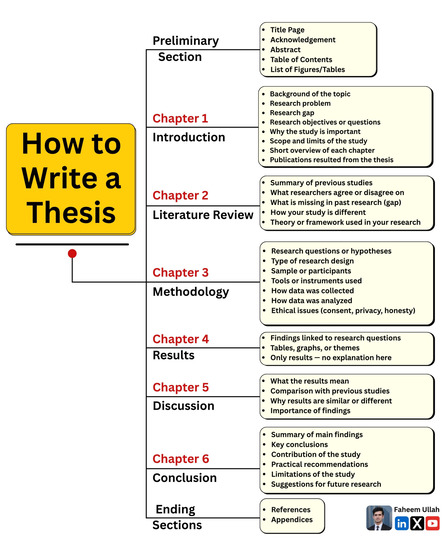
Preliminary Section: Building the Foundation
Before the main chapters begin, every PhD thesis contains several introductory pages. Although these sections are short, they create the first impression of your work.
The title page includes the thesis title, your name, department, university, and submission date. The acknowledgements section allows you to thank your supervisors, family, colleagues, and everyone who supported you during your PhD journey.
The abstract is one of the most important parts of the thesis because it provides a concise summary of your entire research. In just a few hundred words, it should explain the research problem, methodology, findings, and contributions of the study.
The table of contents and list of figures and tables help readers navigate your thesis easily and give it a professional appearance.
Chapter 1: Introduction
The introduction chapter sets the stage for your entire research project. Its main purpose is to convince readers that your research is important and worth investigating.
This chapter should begin by introducing the background of the topic and providing context about the broader research area. You should then clearly explain the research problem and identify the gap in existing knowledge that your study aims to address.
The introduction should also present your research objectives or research questions and explain why your study is significant. In addition, you should define the scope and limitations of your research and briefly describe the structure of the remaining chapters.
One of the biggest mistakes I see among PhD students is that they spend pages discussing the background but fail to clearly identify the research gap. Remember, the research gap is the foundation of your entire thesis. If readers cannot understand why your research is needed, they will struggle to appreciate its contribution.
Chapter 2: Literature Review
The literature review is often one of the longest chapters in a PhD thesis, but it is also one of the most misunderstood.
Many students think a literature review is simply a summary of previous studies. It is not.
A good literature review critically evaluates existing research and answers several important questions:
What do we already know? What do researchers agree on? Where do they disagree? What is still unknown? And how will your study contribute to filling this gap?
This chapter should gradually build the argument for your research and demonstrate your understanding of the field. It should also introduce the theoretical or conceptual framework that guides your study.
One of the most common mistakes in literature reviews is describing papers one by one without any critical analysis. Examiners want to see synthesis and evaluation, not just summaries. They want to know how the existing research connects together and where your work fits into the bigger picture.
Chapter 3: Methodology
The methodology chapter explains exactly how your research was conducted.
This chapter should describe your research design, participants or sample, data collection methods, research instruments, and procedures used to analyse the data. It should also discuss ethical considerations, including consent, confidentiality, and data privacy.
A strong methodology chapter does not simply describe what you did—it explains why you did it. Every decision should have a clear justification.
For example, why did you choose interviews instead of surveys? Why did you use a qualitative approach instead of a quantitative one? Why was a particular statistical test appropriate?
The methodology chapter should be detailed enough that another researcher could replicate your study if needed.
Chapter 4: Results
The results chapter presents the findings of your research.
This chapter should answer one simple question: What did you discover?
Depending on your research, the results may include statistical analyses, tables, figures, graphs, themes, or categories. Each finding should be presented clearly and linked directly to your research questions.
One important rule is that this chapter should only present the findings. You should avoid explaining or interpreting the results here.
A common mistake among PhD students is combining the results and discussion chapters. Doing so often makes the thesis confusing and difficult to follow. Keep this chapter focused entirely on presenting the evidence.
Chapter 5: Discussion
The discussion chapter is where you explain the meaning and significance of your findings.
This chapter answers questions such as:
Why did these findings occur? Do they support previous studies? Why are they different from earlier research? What do they contribute to the existing body of knowledge?
This is the chapter where you demonstrate your ability to think critically and position your findings within the wider academic literature.
Many examiners consider the discussion chapter to be one of the most important sections of a PhD thesis because it shows whether you truly understand your research and its implications.
A weak discussion simply repeats the results. A strong discussion explains the story behind those results and highlights why they matter.
Chapter 6: Conclusion
The conclusion chapter brings your research journey to an end.
This chapter should provide a concise summary of the major findings and clearly state the key conclusions of your study. It should also explain the contributions of the research, provide practical recommendations, acknowledge the limitations of the study, and suggest directions for future research.
Many students make the mistake of introducing new information in the conclusion chapter. This should be avoided. The conclusion is designed to summarise and reflect on the research that has already been presented.
A strong conclusion leaves readers with a clear understanding of the value and impact of your work.
Ending Sections
The final part of your thesis includes the references and appendices.
The reference section contains all sources cited throughout the thesis and should follow the required citation style. The appendices include supporting materials such as questionnaires, interview protocols, ethics approval documents, additional tables, or computer code.
Although these sections appear at the end, they play an important role in demonstrating the credibility and transparency of your research.
Final Thoughts
Writing a PhD thesis can feel overwhelming, but understanding the purpose of each chapter makes the process much easier.
Think of your thesis as a story:
You begin by introducing a problem. You then explain what is already known, describe how you investigated the problem, present your findings, discuss their meaning, and finally explain why they matter.
A successful thesis is not the longest thesis or the most complicated one. It is the thesis that presents a clear, logical, and convincing research story.
Take one chapter at a time, stay organized, and remember that every page you write brings you one step closer to earning your PhD.
The thesis may seem like the final challenge of your doctoral journey, but it is also the document that transforms years of hard work into a lasting contribution to knowledge.
Dear Dr. Faheem,
Thank you so much for sharing your thoughts, now I understood how can I structure my PhD research scholarly meaning how to integrate each chapter chronologically and also each of their paragraph construction logically and their coherence.