

You spend months conducting research. You analyse the data, write the paper, revise it several times, select a journal, and finally click Submit.
Then your manuscript enters a process that can decide whether your research gets published: peer review.
AI tools of the week:
Trinka : The plagiarism checker that saves you hundreds of dollars in report

NOAH : The best AI-powered tool for literature reviews

AnswerThis : An all-in-one platform for assisting you in your research

SciSpace : The best platform for systematic literature reviews

Most researchers are familiar with peer review, but many do not realize that there are several types of academic peer review. In some journals, reviewers know who you are. In others, your identity is hidden. Some journals reveal the reviewers’ names, while others publish the entire review history alongside the paper.
Understanding these different peer review models can help you understand what happens after manuscript submission and what to expect when submitting to an academic journal.
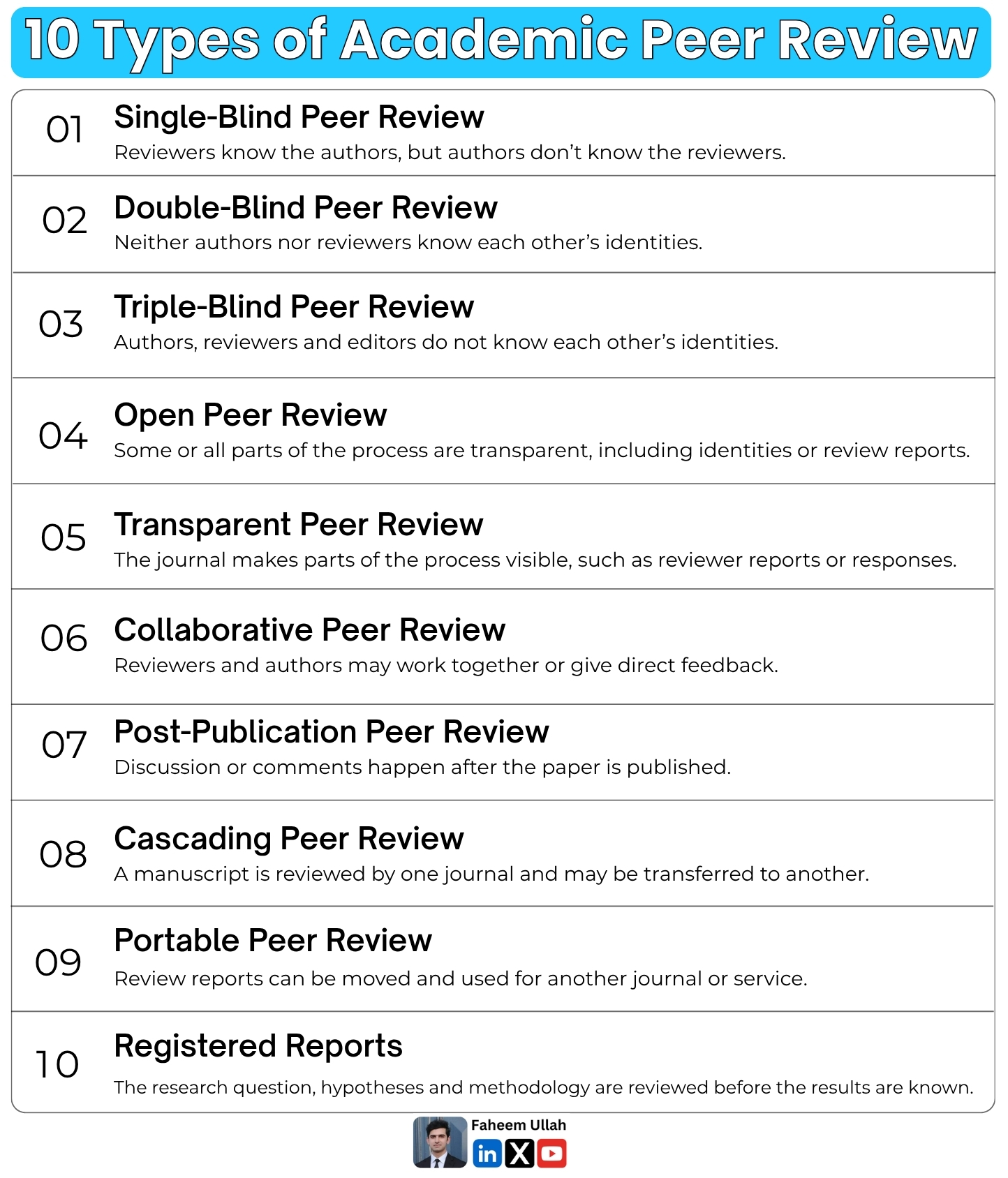
Here are 10 types of peer review every researcher and PhD student should know.
What Is Academic Peer Review?
Academic peer review is a process in which experts in the same or a related research field evaluate a manuscript before or after publication.
Reviewers usually examine questions such as:
- Is the research question important?
- Is the methodology appropriate?
- Are the results supported by the data?
- Are previous studies properly discussed?
- Are the conclusions justified?
- Does the paper make a useful contribution?
- Are there serious errors or limitations?
Based on these reviews, the editor may accept the paper, request revisions, reject it, or occasionally ask for major changes followed by another round of review.
However, journals do not all conduct this process in exactly the same way.
1. Single-Blind Peer Review
In single-blind peer review, the reviewers know the identity of the authors, but the authors do not know who the reviewers are.
For example:
Author → Identity visible to reviewer
Reviewer → Identity hidden from author
This has traditionally been a common form of peer review.
One advantage is that reviewers can understand the authors’ previous work and research background. However, knowing the authors’ identities may potentially introduce biases related to institution, reputation, country, gender, or previous work.
For researchers, the important point is simple: your reviewer knows who you are, but you normally do not know who reviewed your paper.
2. Double-Blind Peer Review
Double-blind peer review attempts to hide both sides’ identities.
The reviewers do not know the authors’ identities, and the authors do not know the reviewers’ identities.
Author → Hidden
Reviewer → Hidden
The main purpose is to reduce potential identity-based bias.
When submitting to a double-blind journal, authors may be asked to remove identifying information from the manuscript. This can include names, affiliations, acknowledgements, and other details that could reveal the research team.
However, complete anonymity is not always possible. In highly specialized research areas, reviewers may sometimes guess the authors from the topic, writing style, datasets, citations, preprints, or previous studies.
Still, double-blind review is widely used as an attempt to make manuscript evaluation less dependent on author identity.
3. Triple-Blind Peer Review
Triple-blind peer review takes anonymity one step further.
Ideally:
Authors do not know reviewers.
Reviewers do not know authors.
Editors handling the evaluation do not initially know author identities.
The goal is to reduce the possibility that reputation, institution, seniority, or personal relationships influence the initial evaluation.
However, triple-blind review can be difficult to implement because editorial systems often contain author information and manuscripts can contain clues about who conducted the research.
It is therefore less common than single- and double-blind review.
4. Open Peer Review
Open peer review moves in the opposite direction.
Instead of hiding identities, some or all parts of the review process become transparent.
Depending on the journal, authors may know the names of reviewers, reviewers may know the authors, and review reports may even be publicly available.
This can increase transparency and accountability.
A reviewer may think more carefully about how feedback is expressed when their identity or report could become public. At the same time, some reviewers may feel less comfortable providing strong criticism when their names are disclosed.
It is important to check the journal’s definition because “open peer review” can mean different things at different journals.
5. Transparent Peer Review
Transparent peer review focuses particularly on making the review process visible to readers.
After a paper is published, the journal may publish material such as:
- Reviewer reports
- Authors’ responses
- Editorial decision letters
- Different versions of the manuscript
The reviewers themselves may still remain anonymous.
This gives readers something that traditional publishing usually hides: the story behind the final paper.
You can see what reviewers questioned, what the authors changed, and how the manuscript developed during the peer review process.
For PhD students, reading published peer review reports can also be an excellent way to learn how experienced researchers evaluate manuscripts.
6. Collaborative Peer Review
In collaborative peer review, reviewers may work together, or reviewers and authors may interact more directly during the review process.
Instead of receiving several completely independent reports, the process can involve discussion and collaboration to produce clearer feedback.
For example, reviewers may discuss disagreements and provide a consolidated report to the authors.
The objective is to make peer review more constructive rather than simply treating it as a judgment of whether a manuscript should survive.
This model can be useful when a manuscript involves multiple disciplines and requires expertise from different areas.
7. Post-Publication Peer Review
Most researchers think peer review happens before publication.
But it can also happen afterwards.
In post-publication peer review, researchers evaluate, discuss, or comment on research after it has been made publicly available.
This recognizes an important reality:
Publication does not mean that scientific discussion has ended.
Once a study is available, other researchers may identify limitations, reproduce experiments, challenge interpretations, or provide additional evidence.
Post-publication review can therefore contribute to the ongoing correction and development of scientific knowledge.
8. Cascading Peer Review
Imagine submitting your paper to Journal A.
The journal decides that your manuscript is not suitable for it but believes it could be appropriate for Journal B from the same publisher or journal family.
Instead of starting completely from zero, your manuscript and sometimes its existing peer reviews can be transferred to another journal.
This is known as cascading peer review or a manuscript transfer process.
The major advantage is efficiency.
Researchers can potentially avoid repeating parts of the submission and review process, while the receiving journal may benefit from existing reviewer comments.
However, the receiving journal normally makes its own editorial decision and may request additional reviews.
9. Portable Peer Review
Portable peer review is based on a similar idea: a useful review should not necessarily be thrown away simply because a manuscript moves to another journal.
Peer review reports may be transferred or “carried” with a manuscript to another participating journal or service.
This can potentially reduce duplication.
Think about a researcher receiving two detailed reviews, revising the manuscript carefully, and then submitting elsewhere after rejection. Under the traditional system, another journal might recruit completely new reviewers and repeat much of the same work.
Portable review attempts to make existing evaluations reusable when appropriate.
10. Registered Reports
Registered Reports change one of the most important parts of traditional peer review: when the research is evaluated.
Normally, researchers complete a study, obtain results, write the manuscript, and then submit it for review.
With a Registered Report, researchers submit the research question, rationale, hypotheses and methodology before the main results are known or analyzed.
Reviewers evaluate whether the research question is valuable and whether the proposed methodology is rigorous.
If the proposal meets the journal’s requirements, it may receive in-principle acceptance. Publication then depends largely on researchers following the approved protocol and meeting the journal’s stated requirements rather than on whether the eventual results are exciting or statistically significant.
This approach is particularly interesting because it can help reduce incentives to prioritize surprising or positive results.
Which Type of Peer Review Is Best?
There is no single peer review model that solves every problem.
Single-blind review protects reviewer identity but may expose authors to identity-related biases.
Double-blind review attempts to reduce those biases, but true anonymity can be difficult.
Open and transparent review can increase accountability, but some reviewers may be less willing to express criticism openly.
Post-publication review encourages continuing scientific discussion, while Registered Reports move part of the evaluation process to before the results are known.
Each system makes different trade-offs between anonymity, transparency, efficiency, accountability, and bias reduction.
What Should You Check Before Submitting Your Paper?
Before submitting a manuscript, do not look only at a journal’s impact factor, ranking, or publication fee.
Check its peer review policy too.
Find out which review model the journal uses, whether your manuscript must be anonymized, whether reviewer reports can be published, whether you can suggest or exclude reviewers, and what happens to your review reports if the manuscript is transferred.
Knowing these details can prevent unnecessary mistakes during submission.
Final Thoughts
Peer review is one of the most important—and sometimes most frustrating—parts of academic publishing.
But it is not one universal process.
From single-blind and double-blind peer review to open review, post-publication review, portable review, and Registered Reports, academic publishing is experimenting with different ways to evaluate research.
For PhD students and early-career researchers, understanding these systems makes the publishing process much less mysterious.
So the next time you submit a paper, don’t just ask:
“Which journal should I submit to?”
Also ask:
“How will this journal actually review my research?”
That small question can tell you a lot about what happens after you click Submit.
Dear Dr. Faheem,
Thank you so much for your important advice!