AI is changing research faster than ever before.
From finding papers in seconds…
To writing drafts…
To analyzing data…
AI tools are now part of a researcher’s daily workflow.
But here’s the problem.
Many researchers are confused.

AI Tools to Make Your Research Easier
 ResearchCollab: Easily Identify and extract data from papers.
 Reviewer3: Get sharp, reviewer feedback before submission.
 Gatsbi: Discover funded PhD opportunities and supervisors.
What is allowed?
What is not allowed?
Where is the line between ethical and unethical AI use?
If you get this wrong, the consequences can be serious:
- Paper rejection
- Academic misconduct
- Damage to your reputation
In this blog, I will explain this in simple and clear terms so you can use AI confidently and responsibly.
Why Ethical AI Use Matters in Research
Research is built on trust.
When you publish a paper, people assume:
- The ideas are yours
- The analysis is yours
- The conclusions are yours
If AI replaces your thinking, that trust breaks.
That’s why journals, universities, and conferences are now focusing heavily on ethical AI use.
The goal is not to stop AI.
The goal is to ensure:
👉 AI supports your work
👉 Not replaces your thinking
The Simple Rule: AI as Assistant, Not Author
Here is the easiest way to understand ethical use:
👉 AI is allowed as a tool
👉 AI is NOT allowed as the creator of your research
If you remember this one rule, you will avoid most problems.
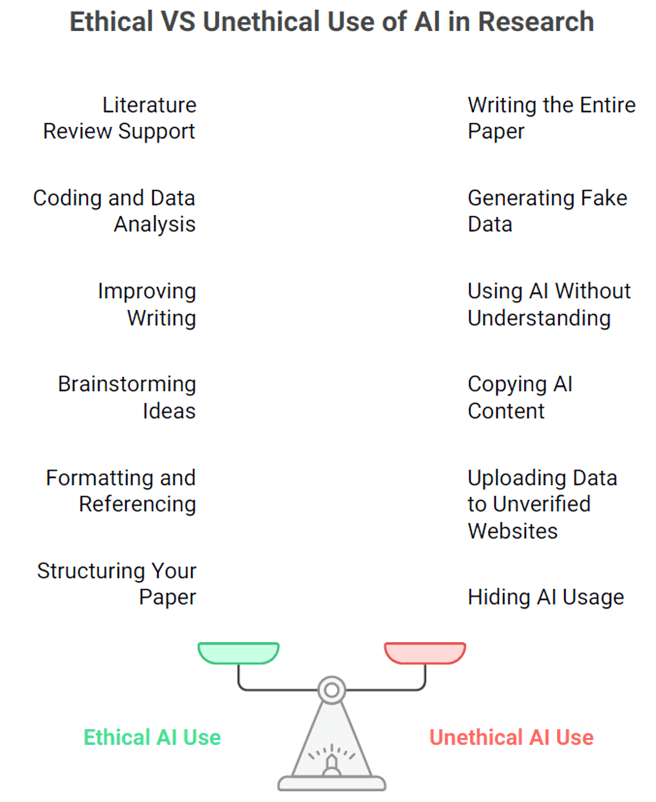
Ethical Uses of AI in Research
Let’s look at what is generally considered acceptable and encouraged.
1. Literature Review Support
AI tools can help you:
- Find relevant papers
- Summarize articles
- Extract key insights
This is completely fine.
Why?
Because you are still:
- Reading the papers
- Understanding them
- Deciding what to include
Example: Using AI to identify 50 relevant papers, then selecting the best 20 yourself.
2. Improving Writing (Grammar & Clarity)
AI can:
- Fix grammar
- Improve sentence structure
- Make writing clearer
This is ethical.
It’s similar to using tools like Grammarly.
Example: You write a paragraph, AI improves readability.
3. Structuring Your Paper
AI can help you:
- Create outlines
- Suggest headings
- Organize content
This is allowed because:
👉 The ideas are still yours.
4. Coding and Data Analysis Support
AI can assist in:
- Writing code
- Debugging
- Explaining algorithms
This is ethical as long as:
👉 You understand the output
👉 You verify results
5. Brainstorming Ideas
AI can help generate:
- Research questions
- Topic ideas
- Possible approaches
This is fine because:
👉 You choose and refine the ideas.
6. Formatting and Referencing
AI tools can:
- Format citations
- Convert styles (APA, Harvard, IEEE)
This saves time and is fully acceptable.
Unethical Uses of AI in Research
Now let’s look at what you should never do.
1. Writing the Entire Paper Using AI
If AI writes your paper and you just copy-paste it:
🚫 This is unethical.
Why?
Because:
- The ideas are not yours
- The analysis is not yours
This is considered academic misconduct.
2. Generating Fake Data
Using AI to:
- Create fake datasets
- Modify results
- Fabricate experiments
🚫 This is a serious violation.
This can lead to:
- Retractions
- Bans from journals
- Loss of credibility
3. Using AI Without Understanding Output
If you:
- Use AI-generated analysis
- But don’t understand it
🚫 This is risky and unethical.
As a researcher, you must:
👉 Fully understand your work.
4. Copying AI Content Without Verification
AI can make mistakes.
It can:
- Hallucinate references
- Provide incorrect facts
If you copy without checking:
🚫 You are responsible for errors.
5. Hiding AI Usage
Many journals now require disclosure.
If you:
- Use AI heavily
- But don’t disclose it
🚫 This can be considered dishonest.
⚖️ Grey Areas (Be Careful Here)
Some areas are not black and white.
You need to be careful.
AI-Assisted Writing
Using AI to:
- Rewrite sections
- Expand paragraphs
This is okay only if:
- You review everything
- You ensure originality
AI for Summarization
Summarizing papers using AI is fine.
But:
👉 Don’t rely blindly
👉 Always cross-check
How to Use AI Ethically (Practical Guide)
Here is a simple checklist you can follow:
✔ Did I understand everything AI generated?
✔ Did I verify facts and references?
✔ Are the ideas truly mine?
✔ Am I using AI as support, not replacement?
✔ Should I disclose AI usage?
If the answer is YES → You are safe.
The Future of AI in Research
AI is not going away.
In fact, it will become:
- More powerful
- More integrated
- More necessary
Researchers who succeed will be those who:
👉 Use AI smartly
👉 Stay ethical
👉 Keep human thinking at the center
Final Thoughts
AI is a powerful tool.
It can:
- Save hours of work
- Improve productivity
- Accelerate research
But it also comes with responsibility.
The goal is simple:
👉 Use AI to enhance your research
👉 Not to replace your thinking
If you follow this principle, you will not only stay ethical…
You will become a better researcher.
Don’t forget to read: Which tool to use in each phase of your PhD?